Students of the Department of Biology of FMIPA IPB Implemented Their Field Work at Taman Buah Mekarsari
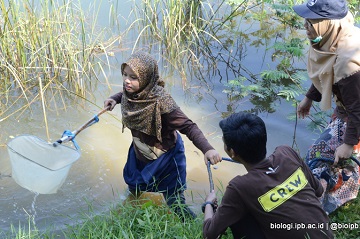
This year, some group of students of the 4th semester of the Department of Biology of Faculty of Mathematics and Natural Sciences of Bogor Agricultural University (FMIPA IPB) implemented their Field Works in Taman Buah Mekarsari (TBM Mekarsari Fruit Garden), Cileungsi, Bogor. The Field Work had been carried out on 25-28 July 2017. The group of students were divided into some small research groups on various biological aspects of TBM. In addition to be the academic activities, the program based on the cooperative work program between the Department of Biology of Faculty of Mathematics and Natural Sciences of Bogor Agricultural University (FMIPA IPB) with TBM.
Items of their Field Work of the Department of Biology of Faculty of Mathematics and Natural Sciences of Bogor Agricultural University (FMIPA IPB), were as follows: The first day was the official reception by TBM. Research and Agronomy Advisor of TBM, Mr. Greg Hambali, presented his welcome remarks, by exposing the overview of TBM. During which Mr. Hambali also stressed the criteria for reliable research programs. Furthermore, Production Division of TBM, Mr. Junaidi Saputra, presented the historical background of TBM, covering its historical background, garden’ philosophy, and various type of gardens in TBM. The first day ended with the preparation of research done the next day.
The second day, all groups of students carried out their practical work for data collection and sampling. They examined the various data ranging from microorganism isolation, epiphytic observation of intruders, anatomical structures and morphology of various plants, carbon stock potential, insect diversity, up to the sleep quality of TBM employees.
One of the research program currently implemented in TBM is gac seed germination. Gac is a fruit produced by Momordica cochinchinensis, which is found throughout the Southeast Asian region from South China to Northeastern Australia, including Thailand, Laos, Myanmar, Cambodia and Vietnam. Typical of orange-colored plant foods, gac fruit contains carotenoids such as provitamin A beta-carotene. Traditionally, gac has been used as both food and medicine in the regions in which it grows. Other than the use of its fruit and leaves for culinary dishes, gac is also used for its medicinal and nutritional properties. Engkay, the student who studies gac seeds, said that this is very interesting program as gac seed with the beauty of its mosaic structure proved quite difficult to germinate in TBM, and is still very rarely cultivated in Indonesia. "We are challenged to find out exactly how to germinate it," he said.
The Field Work Program, beside as curricular work program, it is also functioning to improve the interpersonal relationship between students, teachers and education personnel for students' academic success, through the social programs such as barbeque, campfire and race together. "This activity has been very beneficial for students, Department of Biology, and also TBM. The successful implementation of the Field Work Program will be published as books and displayed in the future exhibitions," said Chairman of the Department of Biology, Dr. Miftahudin.
He stated that present Field Work will contribute to our knowledge on the important contribution of the conservation and sustainable use of biodiversity for urban and industrial areas – (Jonggol and surrounding areas) as well as its potential utilization. (Wied)