IPB University Ecological Genetics Expert: Donkeys Are Not Stupid Animals, They’re Even Smarter Than Horses
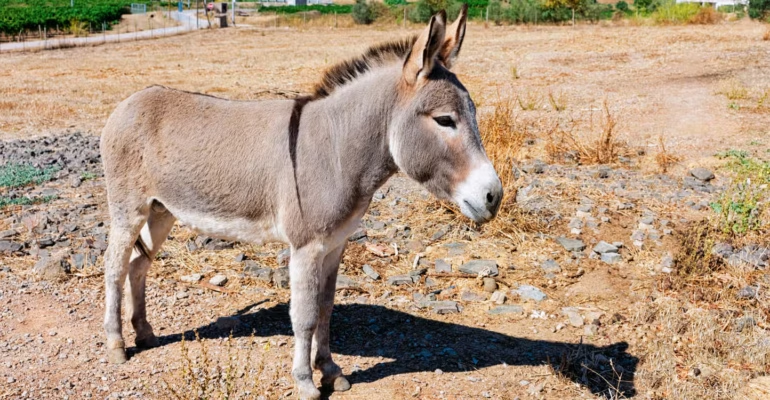
In society, donkeys are often labeled as stupid and stubborn animals. It’s not uncommon for the word donkey to be used to describe negative human behavior. But is this assumption really true?
Prof Ronny Rachman Noor, an Ecological Genetics Expert at IPB University, explains that this stigma stems from the donkey’s tendency to stop and refuse to move when in danger, even when told to do so.
When faced with danger, donkeys stop, observe, and assess the situation, while horses immediately flee. According to him, this behavior or often labeled as stubborn is actually a reflection of the donkey’s intelligence.
“Research findings on behavior and genetics show that donkeys are known to be intelligent. If a donkey stops moving, it indicates that the donkey is observing its surroundings to assess whether it is safe or if there is a lurking danger.
When it comes to assessing environmental safety, donkeys are smarter than horses. This behavior reflects caution, analytical ability, and intelligence as an expression of their survival instinct,” explained Prof Ronny.
Differences in Donkey and Horse Behavior
The differences do not stop at responses to danger. Prof Ronny explained that donkeys are more cautious in analyzing a situation before deciding whether to fight or flee, whereas horses are more impulsive.
Both are social animals, but donkeys live in small groups with strong bonds to their mates, while horses live in larger groups with more complex communication. Donkeys can also hide expressions of pain, whereas horses express it explicitly.
According to Prof Ronny, these differences are related to environmental adaptation. “Donkeys are highly resilient in arid regions such as deserts and nutrient poor environments, whereas horses live in vast, green grasslands. Therefore, donkeys are better adapted to marginal and hot environments.”
Where Does the ‘Stupid’ Stigma Come From?
Donkeys are not native to Indonesia; they originate from North Africa and the Middle East. Folklore passed down through generations from the Middle East and India which reached Indonesia via trade routes helped shape this perception.
“Actually, the expression ‘as dumb as a donkey’ that we often hear is merely a metaphor to describe someone who refuses to learn from their mistakes. This is implied in the original Arabic expression, ‘Al-himaru la yu’allim,’ which means ‘a donkey cannot be taught,’” explained Prof Ronny.
Donkeys, he continued, have also been used as a social symbol for groups of people considered inferior to horses, to the point that this perception has become ingrained in the collective memory. In reality, however, donkeys are in many ways more intelligent than horses.
Genetic Evolution: Mules and Hinnies
Prof Ronny explained that, from an evolutionary perspective, donkeys (Equus africanus asinus) and horses (Equus ferus caballus) are related because they belong to the same genus, ‘Equus’ which evolved from their common ancestor, Hyracotherium, approximately 55 million years ago. Donkeys were domesticated in Northeast Africa around 5.000–4.000 BCE, while horses were domesticated in the Pontic-Caspian Steppe region around 2.200–2.000 BCE.
“Over the course of their evolution, donkeys and horses eventually developed different numbers of chromosomes. Donkeys have 62 chromosomes, while horses have 64. This difference is what causes the offspring of a crossbreeding to be sterile because there are chromosomes that lack a pair,” he explained.
For Prof Ronny, the most fascinating aspect from a genetic perspective is the reciprocal nature of crossbreeding between donkeys and horses, which produces offspring with distinct characteristics. Crossbreeding a female horse with a male donkey produces a mule, which has a body similar to a horse’s but with longer ears, as well as greater endurance and intelligence than a donkey. Conversely, crossbreeding a male horse with a female donkey produces a hinny, a rare hybrid, that is smaller, calmer, and not as strong as a mule.
Thus, Prof Ronny concluded that the expression donkeys are stupid and stubborn is a cultural stereotype and metaphor that does not reflect their actual behavior.
“Donkeys are more cautious and possess deeper analytical abilities, making them intelligent animals with excellent survival strategies,” he emphasized. (*/Rz) (IAAS/KQA)