To Develop the Biodiversity Gallery, IPB University Museum Collaborates with Experts from Various Disciplines
The IPB Future Museum and Gallery are currently designing the Biodiversity Gallery. The gallery is planned to occupy a building that was previously used as a guesthouse. The first floor of this three story building is scheduled to be completed by the end of the year. This project involves inter-faculty collaboration to bring together the campus’s specimen collections into a single interactive educational space.
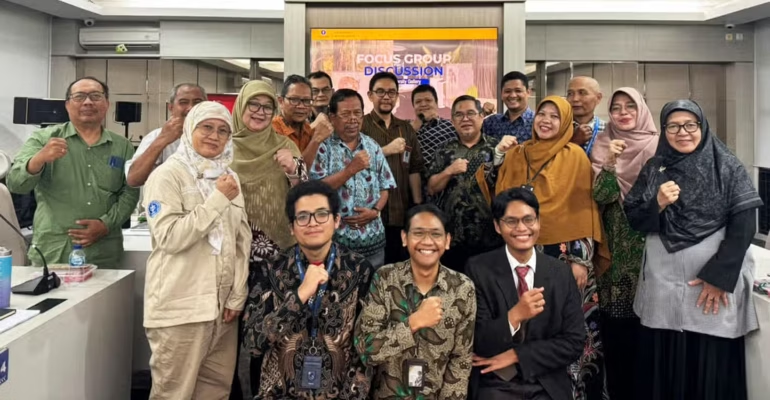
The plan was discussed during a focus group discussion (FGD) held by the IPB Museum last Wednesday (9/30) in Executive Meeting Hall A on the second floor of Building B of the IPB Library. Facilitated by the Vice of the IPB University Board of Trustees (MWA), Dr Rinekso Soekmadi, this discussion brought together perspectives from biodiversity experts from the Faculty of Forestry and Environment, the Faculty of Fisheries and Marine Sciences (FPIK), the School of Veterinary Medicine and Biomedical Sciences (SKHB), as well as university leadership.
Dr Adisti Permatasari Putri Hartoyo, Assistant for Digital Archives and Museum Management at IPB University’s Institute for Information Management and Digital Transformation (LMITD), explained that the gallery was created as a space to showcase IPB’s rich biodiversity. The gallery’s central theme is “The Trinity of Connection,” which links the past, present, and future.
“In the initial design, the gallery was intended to feature a list of species from six ecoregions in Indonesia. However, based on input from various experts, the gallery is now also planned to highlight three levels of biodiversity: ecosystem, species, and genetics,” she explained.
Microorganisms, such as plankton, fungi, and forest microbiomes, are also proposed to be included in the gallery’s narrative. This will broaden the perspective on biodiversity.
According to Dr Adistri, the main challenge in this development is the process of cataloging and relocating the collections.
“Currently, IPB has a large number of specimens ranging from herbarium specimens, wood collections, aquatic collections, to anatomical skeletons scattered across various units. Additionally, temperature and humidity control in the exhibition space must meet conservation standards to ensure the specimens remain well-preserved,” she explained.
In response, she assured that the planned Biodiversity Gallery will address these challenges. To ensure the safety of the original specimens, exhibits can also be presented through digital media, the creation of replicas, or through lending arrangements and collaborative management of the specimen collections.
Vice of LMITD at IPB University, Dr Syafitri Hidayati, concluded the discussion by emphasizing that this Biodiversity Gallery will serve as a shared home for all faculties and schools at IPB.
Through interdisciplinary collaboration, the Biodiversity Gallery will not only serve as a repository for specimens but also function as an interactive educational space, further solidifying IPB University’s status as a Biodiversity Campus. (*/Rz) (IAAS/SSR).