IPB University Faculty Members in Kasembon, Malang, Encourage Farmers and Livestock Raisers to Cultivate Katuk
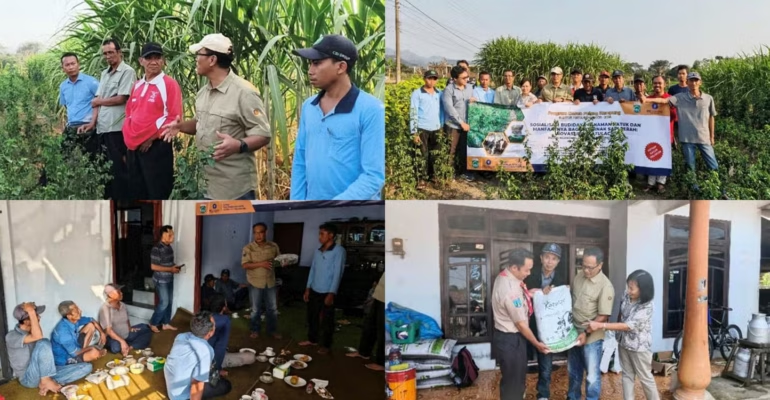
A team of IPB University faculty members visited Kasembon Village, Kasembon Subdistrict, Malang Regency (8/14) to hold an outreach event on the cultivation of katuk as the raw material for the Katulac® innovation.
Led by Prof drh Agik Suprayogi (School of Veterinary Medicine and Biomedical Sciences), accompanied by Dr Efi Toding Tondok (Faculty of Agriculture) and Dr Afton Atabany (Faculty of Animal Science), the event was attended by 15 farmers and livestock breeders who own land and are ready to try growing katuk.
“This program aims to introduce the katuk plant as a commodity with economic value for farmers and livestock breeders, while also encouraging the emergence of pioneer farmers in katuk cultivation within the Kasembon subdistrict,” explained Prof Agik.
According to him, this outreach is crucial, given that the community in Malang Regency, particularly in Kasembon is not yet very familiar with the katuk plant and its benefits for both humans and livestock.
“This is truly unfortunate, considering the vast amount of land that could be optimized to supply dried katuk leaves as raw material for Katulac® production,” said Agik, who is also the innovator behind Katulac®.
Katulac® itself is an innovation derived from katuk leaves that has been processed as a feed additive for ruminant livestock.
Kusnanto, a pioneering farmer in Kasembon Village, admitted that he was initially hesitant to grow katuk because he was unaware of its benefits and economic value.
“Most of us in Kasembon didn’t know that katuk was a beneficial plant with economic value.
“I’ve been trying it since 2023, thanks to Prof Agik. At first, I was skeptical, I wondered if anyone would actually buy this plant. But after I took the plunge, I’ve been able to harvest almost every month and produce dried katuk leaves that I can sell to Bogor for use in Katulac®,” he said.
He added, “I’m glad this event is taking place; IPB’s presence can encourage other farmers and livestock breeders in this area to take an interest in cultivating katuk.”
During the event, the team of professors also took participants on a tour of Kusnanto’s katuk garden. “I just found out that this is the katuk plant. I want to grow it on my land please help me get good seedlings from IPB,” said one of the participants, Jono.
At the farm site, Dr Efi provided explanations and answered participants’ questions regarding the technical aspects of cultivation and potential diseases affecting katuk. She explained that cultivating katuk is very easy, it grows readily, much like cassava. “Plant katuk stem cuttings in well-watered soil with varying planting distances, such as 20×30 cm. Foliar fertilizer, such as urea, can be applied as needed once the leaves begin to grow,” said Dr Efi.
Dr Afton, an expert in livestock production, added that katuk leaves can be beneficial for ruminant livestock. “However, for now, gentlemen, please focus first on katuk cultivation, since its benefits for livestock require a separate processing step before it can be consumed by the animals for example, Katulac®,” he explained.
On the same occasion, Katulac® products were delivered to the farmers’ homes and livestock pens. The team also symbolically handed out katuk cuttings to the farmers in attendance.
“It’s not easy to encourage them to cultivate katuk because it’s not yet widely known. However, with this initiative, we’re confident we can raise their awareness.
It is hoped that before long, the Kasembon area will become a source of raw materials for IPB’s innovations, a factor that has so far been an obstacle to mass production. And most importantly, other katuk farming pioneers will emerge besides Mr Kusnanto in Kasembon,” said Prof Agik. (IAAS/EPK)