IPB University Expert Reveals Unique Facts About Dragonflies: Master Predators with a 95 Percent Hunting Success Rate
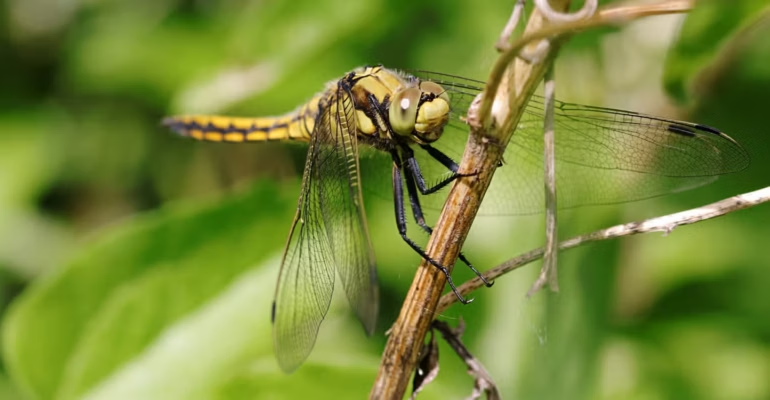
Dragonflies are known not only for their ability to maneuver in the air, but also as predators with exceptional hunting skills.
Dragonflies from the suborder Anisoptera are among the world’s most successful predators, with a prey capture success rate of 95 percent.
“Numerous studies show that Anisoptera dragonflies are the world’s most successful predators. Their predation success rate is far higher than that of many other predators,” said IPB University Entomology Expert Prof Tri Atmowidi.
The professor in the Department of Biology, Faculty of Mathematics and Natural Sciences (FMIPA) at IPB University explained that, taxonomically, dragonflies (order Odonata) comprise two suborders, namely Anisoptera, or common dragonflies, and Zygoptera, or damselflies.
A 2023 study by Rachel Crane, a researcher at the University of California, Davis, reported that dragonflies’ success rate in capturing prey reaches 95 percent, while that of dolphins is around 90 percent, cheetahs around 50 percent, and wolves around 20 percent.
Supported by Advanced Eyes and Nervous Systems
Prof Tri explained that dragonflies’ hunting success is the result of evolutionary adaptations involving their visual system, nervous system, flight capabilities supported by their thoracic musculature, and morphological adaptations.
“Dragonflies have a pair of very large compound eyes that cover nearly the entire head. Each eye is composed of approximately 30.000 individual eye units, or ommatidia.
Dragonfly eyes can see nearly 360 degrees, allowing them to detect the movement of objects above, below, in front, and behind them simultaneously,” he explained.
Their hunting ability is also supported by the central nervous system. Prof. Tri explained that dragonflies possess a population of specialized nerve cells called target-selective descending neurons (TSDNs). “These TSDNs process visual signals from small, moving objects and enable dragonflies to react to their prey’s maneuvers in a matter of milliseconds,” he said.
Four wings directly connected to the thoracic muscles also help dragonflies control their flight and perform rapid maneuvers. In addition, dragonfly legs are equipped with hooks and spines that enable them to capture prey effectively.
Predators Since the Nymph Stage
The dragonfly’s predatory abilities are evident as early as the nymph stage. “Dragonfly nymphs are also effective predators in freshwater ecosystems, preying on mosquito larvae (worms) and other small aquatic animals,” explained Prof Tri.
Nymphs possess specialized mouthparts called labia that can be hydraulically propelled forward using body fluid pressure to capture prey. Their predation success rate ranges from 60–70 percent.
“Based on a meta-analysis, a single dragonfly nymph can consume an average of 40 mosquito larvae per day,” he stated. Nymphs also prey on the larvae of Aedes, Anopheles, and Culex mosquitoes. Adult dragonflies also play a role as mosquito predators on land.
In addition to being natural predators, dragonflies can serve as bioindicators of environmental health because their nymphs are sensitive to water pollution and decreases in dissolved oxygen levels.
“The presence of an abundant dragonfly population in a region indicates that the water and environmental quality in that area are still clean and have not been heavily contaminated by pollutants,” concluded Prof Tri. (Fj) (IAAS/LAN)