IPB University Expert: Seedless Fruit Does Not Mean Plant Reproduction Has Stopped
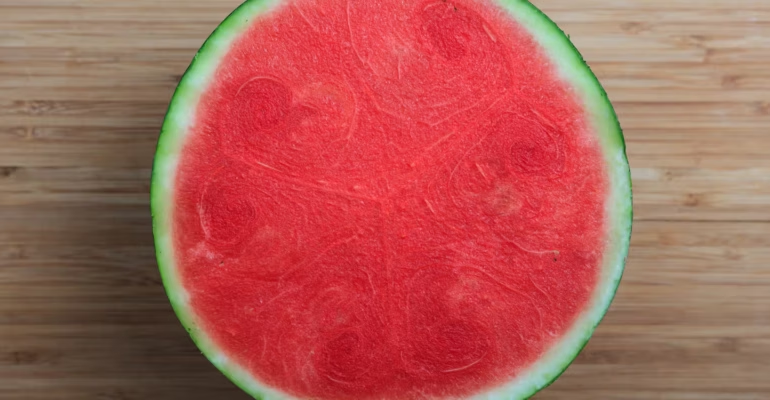
Seedless fruit is often seen as a sign that plant reproduction has stopped. However, according to Prof Sobir, a plant breeding expert at IPB University, this assumption is incorrect.
“Seedless fruits can form through certain natural biological mechanisms or artificial treatments, so plants can still reproduce in other ways,” explained Prof Sobir.
How Are Seedless Fruits Produced?
One of the best known examples of a seedless fruit is the watermelon. Prof Sobir explained that seedless watermelons are produced by crossing tetraploid plants with diploid plants, resulting in triploid plants.
“Triploid plants have an unbalanced number of chromosomes during gamete formation (pollen or egg cells), so they are unable to produce seeds normally during fertilization,” he elaborated.
Although they cannot produce seeds, triploid plants are still capable of forming fruit, as the pollination process induces fruit formation. Thus, the fruit forming process still requires pollination using fertile pollen from diploid watermelons.
“Pollination induces fruit formation, but due to the chromosomal imbalance, the seeds do not develop properly, so the resulting fruit is practically seedless,” explained Prof Sobir, who is also a full professor at the Faculty of Agriculture, IPB University.
In addition to genetic mechanisms, seedless fruit can also form when pollination occurs but fertilization fails. Pollination still stimulates the development of the ovary, while seeds either fail to form or develop into empty seeds.
Seedless fruit can also be produced through the application of plant hormones, such as auxin and gibberellin. These hormones can stimulate the development of the ovary without the fertilization process.
“In Japan, for example, unopened flowers are dipped in a gibberellin solution so that the fruit can develop without producing seeds. A similar technique has also been applied to tomato plants,” added Prof Sobir.
Can Seedless Fruits Be Cultivated?
So, how are seedless plants still cultivated? Prof Sobir explained that in the case of seedless watermelons, diploid and tetraploid parent plants are still propagated naturally because both produce seeds used to produce triploid plants.
Meanwhile, various other seedless fruit plants are propagated vegetatively through techniques such as grafting, layering, or tissue culture. “Thus, the absence of seeds in the fruit we consume does not mean the plant loses its ability to reproduce,” emphasized Prof Sobir.
More Practical, But…
From the consumer’s perspective, seedless fruits offer convenience because they are easier to eat and have more edible parts. However, according to Prof Sobir, there is a consequence to consider: the potential for a decline in flavor.
“The processes of pollination and fertilization influence the formation of compounds intended to protect the embryo within the seed, and these compounds can also enhance the fruit’s flavor. Therefore, for some types of fruit, seedless varieties may not necessarily taste better than their seeded counterparts,” he explained.
He cited the example of seedless watermelons, which are less popular in Japan because they are considered inferior in taste compared to seeded watermelons.
In addition to flavor quality, the development of seedless fruits must also take into account the sustainability of plant genetic diversity. If seedless plants become too dominant, genetic diversity may decrease, making plants more vulnerable to environmental changes as well as pest and disease attacks.
“Therefore, genetic resources, including heirloom plants, must continue to be preserved through germplasm collections and breeding programs,” he added.
Looking ahead, Prof Sobir believes that innovation does not always have to focus on eliminating seeds. Developing fruits with smaller seeds or seeds concentrated in specific areas could be an alternative, ensuring the fruit remains easy to consume without sacrificing flavor or the plant’s reproductive sustainability.
“Fruit innovation should maintain a balance between consumer needs, product quality, and the conservation of plant genetic resources,” he concluded. (Ez) (IAAS/LAN)