Bringing the Lab to the Rice Fields, IPB University Launches Its First Mobile Plant Clinic Safari
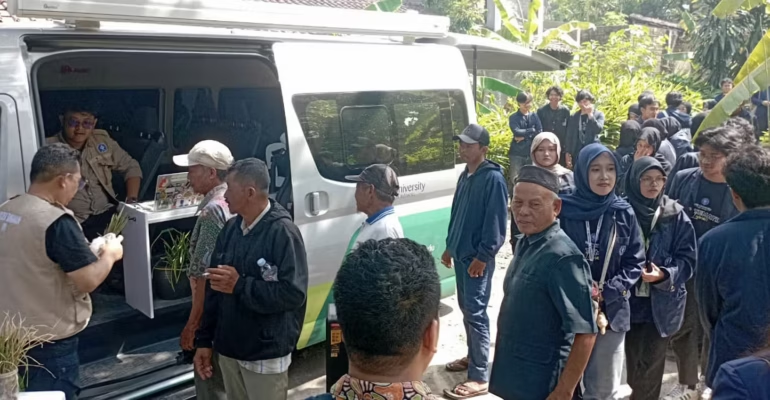
IPB University has launched its first Mobile Plant Clinic Safari program to bring consultation services, expedite diagnoses, and provide recommendations for plant pest and disease control directly to farming communities. This tour covers seven rice producing centers, which are Boyolali, Sukoharjo, Klaten, Demak, Grobogan, Indramayu, and Subang (7/30–8/4).
The initiative is part of IPB’s Quick Response program in response to reports of increasing infestations of stem borers, brown planthoppers, and rats toward the end of the second planting season of 2026.
Unlike the traditional service model, which requires farmers to bring samples to the campus, IPB University’s Mobile Plant Clinic brings a mobile laboratory directly to rice fields, gardens, and villages. Farmers can consult directly, point out symptoms on their plants, and discuss control recommendations based on actual field conditions. This approach allows farmers’ issues to be addressed more quickly and in a science based manner.
During a discussion with farmers, Dr Rachmat, Director of Food Crop Protection at the Directorate General of Food Crops, Ministry of Agriculture, who was present in person, emphasized the importance of integrated pest management (PHT) and farmer autonomy. Both are essential prerequisites for achieving national food security, particularly for staple foods.
“The government is promoting the implementation of PHT through a number of programs, one of which is the establishment of Biological Control Service Posts. This program encourages farmers to become more self reliant in crop management,” he said.
In his presentation, Rector Dr Alim Setiawan Slamet stated that IPB University continues to strive to engage closely with farmers and provide direct services to help them resolve various real world problems in the field through various community service programs.
“IPB is currently carrying out community service through 4.500 students participating in the Community Service Program (KKN) across Indonesia. In addition to students, IPB experts and academics are present through the ‘Faculty Return to the Village’ program and the Plant Clinic to assist communities in facing challenges, including pest outbreaks and climate change,” he said.
He added, “IPB is very open to collaborating with the community, local universities, and local governments to develop innovations and address these various challenges.”
Preemptive Strategy Collaboration
In Sumber Village, Trucuk Subdistrict, Klaten Regency, an IPB University team led by Professor Hermanu Triwidodo, a full professor at the Faculty of Agriculture, is working alongside the Nahdlatul Ulama Agricultural Development Institute (LP2NU) in Klaten to develop a preemptive control strategy to safeguard rice production. This approach emphasizes agroecosystem monitoring, early risk identification, and decision-making before an infestation escalates into an outbreak.
According to Prof Hermanu, it is not enough to simply provide farmers with the names of pests and a list of pesticides. What is more important is understanding why problems arise, when action needs to be taken, and how to control them without harming natural enemies or the health of the agroecosystem.
“Diagnosis must lead to prevention strategies that farmers can implement. That way, problems can be resolved immediately, and farmers become an active part of pest and disease control efforts, not just passive recipients,” explained Hermanu.
Wardiyono, a farmer and Chair of LP2NU Klaten, welcomed this initiative as highly beneficial. Farmers need support from the university to address various issues, particularly those related to pests and diseases.
“For us, services like this bridge the gap between farmers and the university. We can directly show the condition of our crops, understand the causes, and then choose the appropriate course of action. We hope this assistance doesn’t end with a single visit but continues to help us prepare for the next planting season,” emphasized Wardiyono.
In addition to Klaten, the outreach program will continue to Pasir Village, Mijen Subdistrict, Demak Regency. Through this initiative, the Rector of IPB University hopes to gather feedback for research, education, early warning systems, and improvements to plant protection services. At the same time, farmers gain faster access to knowledge and control options that are safe, effective, and tailored to local conditions. (*/Rz) (IAAS/WSG)