
IPB University Welcomes Plans to Strengthen the Halal Gelatin Industry, Suggests Alternative Raw Materials from Fisheries Waste
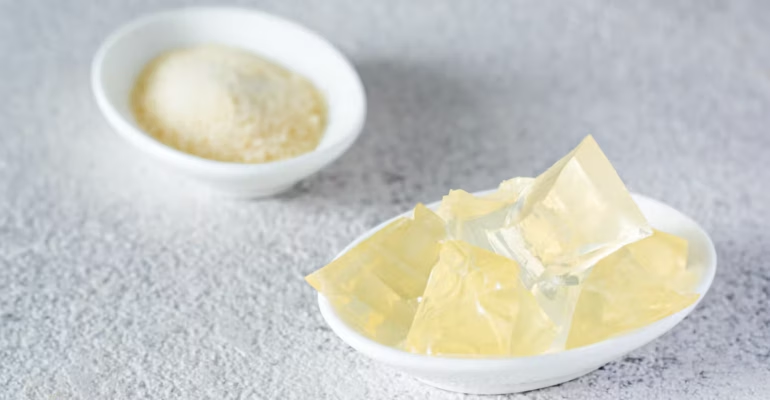
Chairman of the Halal Science Center at IPB University, Prof Khaswar Syamsu, welcomed the Indonesian government’s plans to strengthen the halal gelatin industry in order to reduce dependence on foreign imports.
He stated that imported collagen and gelatin that have not been certified as halal are highly likely to be non-halal, as the majority (>60%) are derived from pig skin and bones. Although some also come from cow skin and bones, they remain haram if the cows were slaughtered in a manner not compliant with Islamic law.
“Just as with meat, domestic demand for collagen and gelatin exceeds the capacity of the domestic livestock industry to supply it. To meet domestic demand, Indonesia must import these products from meat-producing countries, such as Australia, New Zealand, China, Brazil, India, and others,” said Prof Khaswar (7/20).
The professor in the Department of Agricultural Industrial Technology at IPB University added that producing halal collagen and gelatin domestically not only guarantees their halal status but also saves the country foreign exchange that would otherwise be spent on importing collagen and gelatin.
“If domestic production exceeds demand, this collagen and gelatin can be exported, primarily to countries that require halal collagen and gelatin, thereby potentially generating foreign exchange,” he said.
Gelatin Alternatives from Fisheries Waste
Prof Khaswar explained that collagen and gelatin can also be obtained from the skin, scales, bones, and swim bladders of fish, which have significant potential in Indonesia. Although they have different characteristics, fish collagen and gelatin have proven capable of substituting for, and even outperforming, cattle and pork derived products for certain uses.
Due to the high demand for halal gelatin, the Halal Science Center at IPB University is conducting research on the use of fisheries industry waste. such as fish skin, scales, bones, and swim bladders, as sources of halal collagen and gelatin to replace imported products whose halal status remains questionable.
“A research team led by Prof Mala Nurilmala from the Faculty of Fisheries and Marine Sciences (FPIK) at IPB University has successfully produced collagen and gelatin from these fishery industry byproducts, which are then processed into collagen beverages for health and capsule shells for pharmaceuticals. Research and technological development to produce collagen and gelatin from fishery industry waste are still ongoing,” said Prof Khaswar.
In addition, IPB University is also facilitating research on halal gelatin through technical guidance on preparing raw materials from fishery waste for fishermen and micro, small, and medium sized enterprises (MSMEs) in Tegal, supported by the Bestari Saintek program and Waqf Funds from Indosat. These ready to use materials will eventually be supplied to processing industries, and the collaboration model is ready to be replicated in various regions in partnership with Bank Indonesia. (MHT) (IAAS/STD)

