Strengthening Cooperative Services, IPB University and KUD Bayongbong Collaborate to Increase Dairy Production
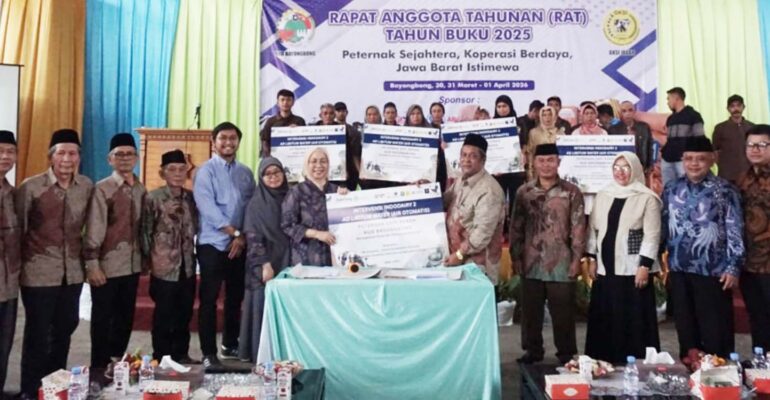
The IndoDairy 2 team of IPB University has officially established a strategic partnership with Village Unit Cooperative (KUD) Bayongbong to boost dairy cow productivity through the modernization of cooperative services.
This collaboration was marked by the signing of an agreement and the distribution of an automatic drinking water system (ad libitum water), carried out during the Annual Member Meeting (RAT) of KUD Bayongbong in Garut.
The program is supported by funding from Australian Centre for International Agricultural Research (ACIAR) to support the Milk Production Improvement per Cow (P2SP) program.
The assistance provided to 20 cooperative member farmers includes water tanks, green drinking bowls, PVC pipes, and other installation equipment. Prof Sahara, In-Country Coordinator of IndoDairy 2, explained that this system allows cows to drink according to their physiological needs, helping maintain metabolic balance.
“Ad libitum water has the potential to increase milk productivity. From the farmers’ perspective, this system improves efficiency in time and labor for water provision and simplifies herd management,” explained the Director of International Trade Analysis and Policy Studies (ITAPS), Faculty of Economics and Management, IPB University.
The Chairman of KUD Bayongbong, H Roni, welcomed this research intervention as a step toward cooperative transformation in adapting to modern developments. He expressed hope that the innovation will not only benefit program participants but also be widely adopted.
“It is important for cooperatives to continuously adapt to digital technology to remain relevant. Hopefully, more farmers will begin adopting innovations such as this automatic drinking water system,” he stated.
The three day activity was also attended by representatives from the Garut Office of Cooperatives and SMEs, as well as the Indonesian Dairy Cooperatives Association (GKSI), emphasizing that such collaboration is key to competitiveness.
With transparent governance, this synergy between academia and cooperatives is expected to serve as a sustainable model to strengthen farmers’ capacity and improve the welfare of Indonesia’s dairy sector. (MW) (IAAS/CAA)