IPB University Expert Highlights the Risks of Indonesia’s Reliance on Cattle and Buffalo Imports from Australia
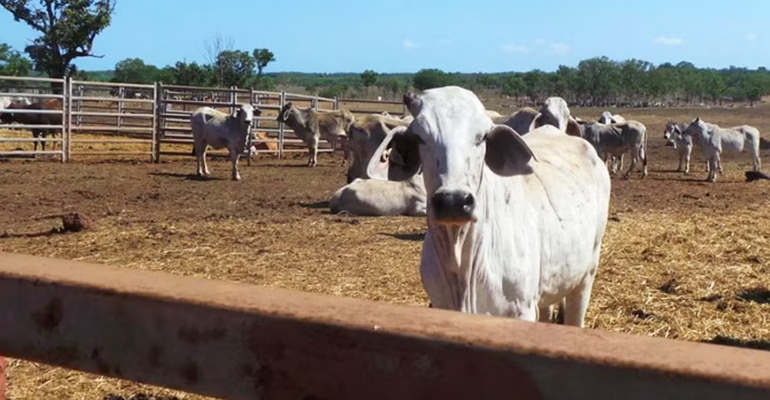
Prof Ronny Rachman Noor, an expert in ecological genetics at IPB University, revealed that Indonesia currently remains dependent on imports of cattle hides, live cattle, and buffalo, particularly from Australia. This is because domestic production is still insufficient to meet the country’s demand for meat, milk, and hides.
“Indonesia has to import cattle and buffalo because local breeds, such as the Bali and peranakan ongole (PO), grow slowly and have low productivity. Cattle distribution is not yet evenly spread. They are concentrated in East Nusa Tenggara, Sulawesi, and Central Java, while demand is high in Jakarta and West Java,” he said.
In addition, Prof Ronny continued, demand continues to surge in line with the growth of the middle class and the expansion of the hotel and restaurant industries, as well as the implementation of the Free Nutritious Meals (MBG) program.
He explained that Australia has become one of the preferred countries for importing cattle due to its advantageous geographical proximity, competitive prices (US$4 or approximately Rp71.000 per kilogram of live weight), high quality livestock particularly Brahman Cross cattle and a well-organized export system. In 2025 alone, live cattle imports from Australia are projected to reach 583.000 head, with a total commodity value of US$611,6 million.
In addition to live cattle, Australia also dominates more than 60 percent of Indonesia’s imported frozen beef market, including exports of offal valued at US$127 million in 2025. Furthermore, Indonesia imported approximately 1.031 metric tons of cowhides worth US$0,86 million in 2023.
“Australian cattle hides generally come from Brahman Cross cattle and feedlot cattle, which are characterized by their thickness and uniformity, making them suitable for the shoe, bag, and furniture industries. Interestingly, these imports are also consumed, such as when made into hide crackers,” explained Prof Ronny.
For buffalo commodities, Indonesia accounted for 3,52 percent of global imports and ranked among the world’s top four importers, following the United States (U.S.) and Egypt. Throughout 2023, Indonesia imported live buffalo worth US$3,54 million from Australia’s Northern Territory, with import volumes fluctuating and often peaking ahead of Eid al-Adha.
Prof Ronny warned that this reliance on imports from Australia creates economic vulnerability, especially when the rupiah weakens against the Australian dollar (AUD). When the rupiah depreciates, the cost of purchasing imported cattle and buffalo automatically rises.
“Reliance on Australia is risky because it makes Indonesia vulnerable to economic, supply, and political fluctuations. Expanding imports from India, Brazil, the US, and New Zealand is a safer approach for food security and beef price stability,” advised Prof Ronny.
In addition to diversifying import sources, Prof Ronny also suggested that Indonesia strengthen domestic industries such as feedlots, breeding, and leather. Furthermore, other measures include managing exchange rate risks through hedging and long term contracts.
This strategy helps Indonesia maintain beef prices, food security, and economic sovereignty when the rupiah weakens and the political situation is unstable. (MHT) (IAAS/LAN)