IPB University Students Develop SiMata, an AI Based Initial Screening System for Narcotics, Psychotropic Drugs, and Addictive Substances (NAPZA) Using Pupil Responses
Detecting the abuse of narcotics, psychotropic drugs, and addictive substances (NAPZA) is not always easy. Conventional screening methods typically require specific procedures and facilities.
Addressing this issue, five IPB University students designed SiMata, a non medical preliminary screening system based on pupil response analysis and artificial intelligence (AI).
Team representative Dwina Sarah Diva explained that the idea emerged because drug abuse in Indonesia has evolved into a multidimensional threat that endangers the quality of human resources and national resilience.
Data from the National Narcotics Agency (BNN) shows that the prevalence of drug abuse in 2023 reached 1,73 percent of the total population aged 15–64, equivalent to approximately 3,33 million people.
“In the field, behavioral changes such as emotional instability or a decline in self-control are often dismissed as mere ‘typical teenage mischief”, so signs of substance exposure are recognized too late and treatment becomes less than optimal,” she said.
According to her, conventional detection methods such as urine, blood, hair, and saliva tests have limitations in terms of accuracy, detection time windows, and the need for specialized facilities. “Their invasive nature and high cost make these methods difficult to implement routinely and periodically in school and college settings,” she added.
Pupils as Indicators
The SiMata concept is based on research findings that exposure to psychoactive substances specifically and rapidly affects pupil diameter. This response is analyzed using an internal camera through image processing and a convolutional neural network (CNN) algorithm to recognize dynamic patterns of pupil size changes in response to light stimuli.
The system then categorizes the results into three groups: 1) safe, 2) requires further examination, and 3) requires attention. Anonymized individual data is designed to be integrated into a national database.
Dwina emphasized that SiMata is intended purely as an initial screening tool, not a definitive diagnosis or a substitute for formal medical tests.
Toward Implementation
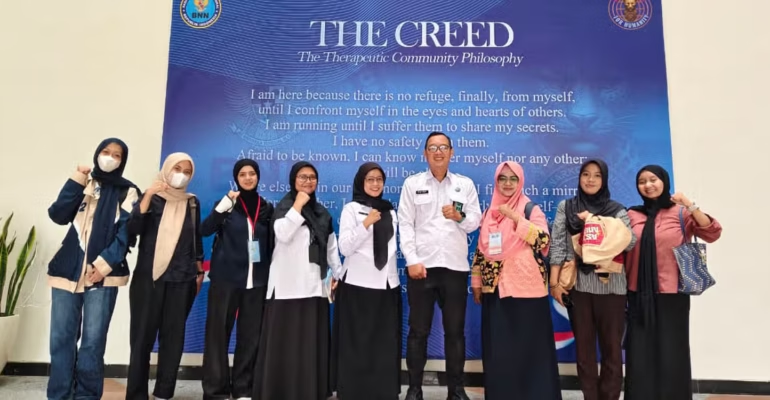
Currently, the team has held meetings with the National Narcotics Agency (BNN) of Bogor Regency and is partnering with SMK Pembangunan to produce educational videos.
“Through this innovation, we hope to provide a non-invasive, rapid, and more affordable initial screening tool to support early detection in schools and on college campuses,” she said.
The initiative is also aimed at fostering a safer educational environment, promoting preventive interventions such as counseling and education, and paving the way for more data driven drug prevention policies.
SiMata successfully secured funding from the 2026 Student Creativity Program in the Constructive Video Ideas category (PKM-VGK). In addition to Dwina, the team consists of Fahriatu Saidah, Citra Putri Marlin, Jihan Delly Naysilla, and Najwa Alya Kamaludin, under the guidance of Dr Medhanita Dewi Renanti. Now, Dwina and the team are committed to advancing this idea toward the National Student Scientific Week (Pimnas) this coming November. (dh) (IAAS/HNF)