NbS Research Collaboration, IPB and Waterloo Students Design Early Warning Systems for Floods and Fires
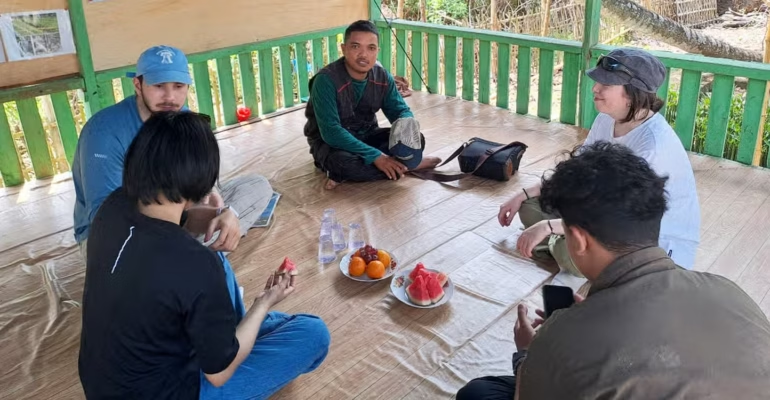
A cross disciplinary collaboration between the Faculty of Forestry and Environment (FAHUTAN) at IPB University and the University of Waterloo in Canada has successfully produced a number of research projects and technological innovations to address the challenges of ecosystem restoration and disaster risks.
Through the “FINCAPES Project” international internship program, students from IPB University and the University of Waterloo conducted research on Nature based Solutions (NbS), climate finance, and Internet of Things (IoT) based early warning systems for floods and fires.
Research activities are centered at the IPB Center for Applied Research in Nature-based Solutions (I-CAN) Living Laboratory, located in Jambi and Lampung. I-CAN is a multidisciplinary research center that serves as a platform for collaboration among academics, students, practitioners, researchers, and local communities to generate science-based solutions to various environmental and socio-economic challenges at the grassroots level.
Disaster Early Warning System
One of the achievements of this collaboration is the development of the DIY Flood and Fire Early Warning System (FFEWS), an early warning system designed to be affordable and implementable in areas with limited infrastructure. As of August 2026, the system architecture and hardware design have been fully developed, while a prototype IoT sensor has been successfully assembled for testing in Muaro Jambi.
As part of the project, students from the University of Waterloo developed a digital system, web dashboard, API, database, IoT and cloud device connectivity, and an automated notification system. Meanwhile, Indonesian students assembled sensors, installed communication modules, integrated solar panels and batteries, and conducted testing and installation of the devices on the Gelam and Tangkit Rivers in Muaro Jambi Regency.
“The collaboration with the University of Waterloo through the FINCAPES Project reinforces FAHUTAN IPB University’s commitment to integrating education, applied research, and innovation in addressing the challenges of climate change. The I-CAN Living Laboratory serves as a vital space to ensure that nature-based solutions do not remain mere concepts but are tested in collaboration with local communities,” said Prof Dodik Ridho Nurrochmat, Dean of FAHUTAN IPB University.
The collaboration is carried out through the University of Waterloo’s Cooperative Education (Co-op) program, an educational model that combines academic learning with professional experience in a real world work environment.
A total of six University of Waterloo students from the fields of Environment and Business, Geography, Computer Engineering, Electrical and Computer Engineering, and Data Science are participating in this program.
In addition to early warning technology, the students are also developing a Results-Based Management (RBM) model, conducting socio-ecological research in mangrove areas, mapping funding opportunities, and studying climate finance in collaboration with the Purnomo Yusgiantoro Center (PYC).
“This collaboration expands the education and research ecosystem through international internship programs, field-based learning, socio-ecological research, climate finance, and IoT-based early warning system innovations,” explained Dr Dede Aulia Rahman, Associate Dean for Academic Affairs, Student Affairs, and Alumni at the Faculty of Forestry (FAHUTAN), IPB University.
For students at the University of Waterloo and in Indonesia, this program serves as a transformative learning experience to understand that complex environmental challenges can only be addressed through interdisciplinary, inter-institutional, and transnational collaboration.
Moving forward, FAHUTAN IPB University hopes this partnership can be expanded into a long-term educational and research collaboration, including through the development of joint publications, technological innovations, student and researcher exchanges, and the replication of NbS models across various priority landscapes in Indonesia. (*/Rz) (IAAS/HNY)