Mindshift 5: IPB’s PKM Team Encourages Former Female Migrant Workers to Create Value Added Catfish Products
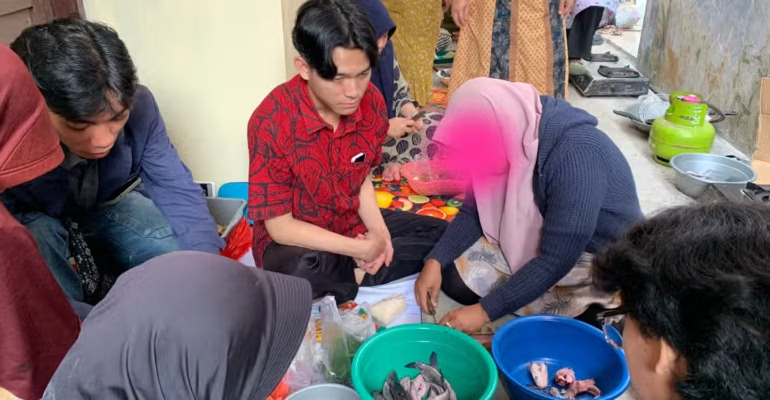
The Student Creativity Program in Community Service (PKM-PM) team at IPB University continues to provide guidance to former female migrant workers in Kampung Muara, Jambenenggangn Village, Kebonpedes Subdistrict, Sukabumi Regency.
After equipping them with integrated aquaculture skills through the integrated multi trophic aquaculture (IMTA) system, the team is now focusing on enhancing their skills in processing aquaculture products into value-added food items through a program titled “Mindshift 5: Kreasi Wargi.”
From Aquaculture to Downstream Processing
Soni Kurniawan, a team representative, explained that Mindshift 5 is part of the Mindshift (Mindset & Independent) program, which emphasizes the importance of value-added processing of aquaculture products.
“After understanding the process of sustainable catfish farming, participants were encouraged to develop their creativity in processing the harvest into various culinary products with higher economic value,” he said.
Through a learning by doing approach, participants not only learn processing techniques but are also encouraged to innovate based on the potential and creativity of their respective groups.
The event began with an introduction to the potential for adding value to catfish through food processing, including the importance of maintaining product quality, applying food safety principles, and identifying marketing opportunities for processed products as a foundation for developing aquaculture based businesses.
Three Processed Creations
The facilitator then demonstrated the stages of raw material preparation, catfish meat processing, ingredient mixing, forming catfish fillet based burger patties, and product packaging techniques.
Participants were then divided into three groups to conduct hands-on practice under the guidance of the IPB University PKM-PM team. Each group prepared catfish fillet burgers as their main product and developed one creative catfish dish.
The first group presented crispy catfish with sweet and sour sauce, the second group prepared catfish pecel with liwet rice, while the third group served pepes lele with green chili sauce.
“Participants are not only able to process their aquaculture products but are also beginning to gain the confidence to create products with higher market value,” said Soni.
Ready for Scaling Up
The participants, together with the facilitators, also developed recipes and production standards to serve as guidelines for processing at the group level. The basic recipe for the catfish fillet burger and each group’s creative dishes were documented so they can be reproduced consistently while maintaining quality.
The series of activities concluded with a product evaluation based on taste, texture, hygiene, product appearance, and the appropriateness of the production process. Through Mindshift 5: Kreasi Wargi, Sonny and his team hope that participants will be better prepared to develop innovative and sustainable businesses based on the processing of farmed products, while also strengthening the community’s economic self reliance. (*/Rz) (IAAS/KQA)