A Team of IPB University Faculty Members Encourages Mulyaharja Residents to Practice Simple Urban Farming Through the Budikdamber Method
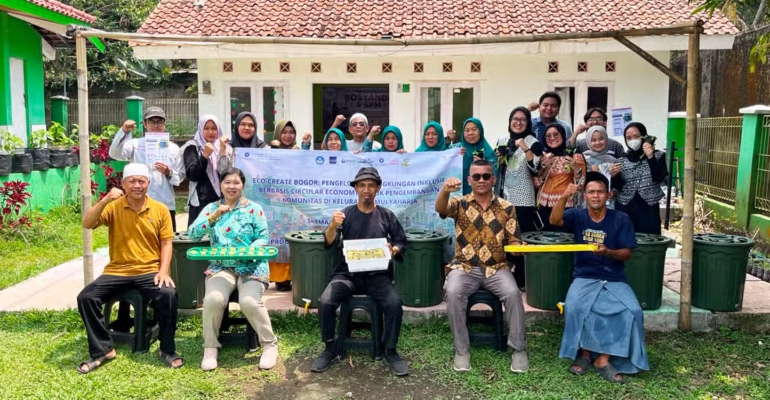
Limited land does not have to be an obstacle for communities to produce food. Through urban farming, fish and vegetables can even be cultivated simultaneously using simple tools right in their own backyards.
This approach was introduced by a team of IPB University faculty members to the community of Mulyaharja Village, Bogor City, through the “Eco-Create Bogor: Urban Farming Training Using the Budikdamber Method (Fish Farming in Buckets)” program.
This activity is part of the Promoting Research and Innovation through Modern and Efficient Science and Technology Parks (PRIME STeP) 2026 program, which aims to educate and empower the community through practical, land-efficient, and environmentally friendly applications.
The program team leader, Dr Doni Sahat Tua Manalu, stated that this training aims not only to introduce simple technology but also to encourage the community to independently develop urban farming practices.
“Through this activity, we aim to foster a shared experience among the team, the urban village government, community groups, and residents. Thus, the community is not merely a participant but is also expected to become an active agent capable of independently developing these urban farming practices in the future,” said Dr Doni.
The event, held at the Mulyaharja Urban Village Posyandu, was attended by community members and representatives from local groups. Mulyaharja Subdistrict Chief Muslim Yuliantono, SSos, MSi, praised the event for providing residents with practical knowledge and skills.
“We greatly appreciate this event because it gives the community the opportunity to learn new ways of producing food from their immediate surroundings. We hope the knowledge gained can be applied and developed by residents on their own,” said Muslim.
During the training, team member Dr Roza Yusfiandayani explained the budikdamber system, which uses buckets as fish-rearing containers, while water spinach is grown in net pots placed on top of the buckets. The equipment used included buckets, catfish fry, water spinach seedlings, net pots, growing media such as rockwool, and fish feed.
In the budikdamber system, it’s not just about how the fish are raised, but also how the system is maintained so that both the fish and the plants can thrive. Therefore, participants need to understand the stages of preparation, maintenance, feeding, and water management,” said Dr Roza.
The team members included Dr Roza Yusfiandayani, Andini Tribuana Tunggadewi, SE, MSi, Wiranda Intan Suri, ST, MT, Kharisma Fitri Hapsari, SE, MSi, and students from IPB University.
Participants were also provided with guidance on maintenance, including feeding, water conditions, fish stocking density, and plant growth. This is important because the success of pond-based aquaculture depends heavily on routine maintenance.
This initiative is expected to serve as an alternative form of urban farming for utilizing limited land while strengthening food security for the Mulyaharja community. (IAAS/EPK)