IPB University Students Optimize the Potential of Bio-Slurry for Sustainable Agriculture in Tegal Waru Village
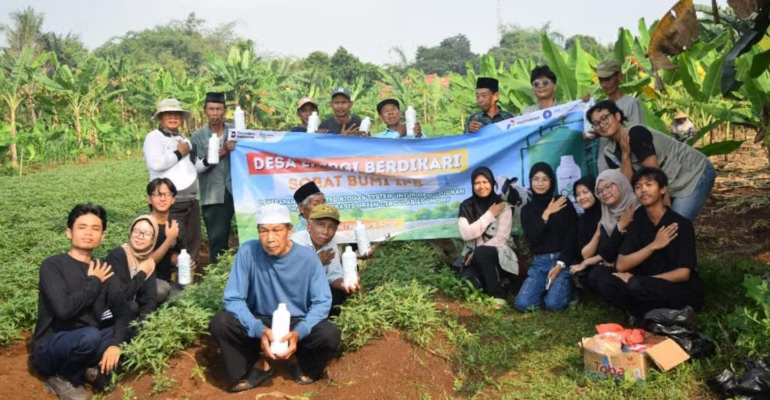
IPB University students who are recipients of the Sobat Bumi Scholarship (SOBI IPB) carried out a community service program through the Self-Reliant Energy Village (DEB) initiative in Tegal Waru Village, Ciampea District, Bogor, West Java (8/3–4).
The series consisted of the Bio Kreasi and Bio Tani programs, carried out together with volunteers from the Energize Squad. These programs aim to increase the utilization of livestock waste from biogas installations into value-added products such as liquid organic fertilizer (POC) and biofertilizers that can support sustainable agriculture.
“The Desa Energi Berdikari program was launched as an effort to promote a circular economy at the village level. We are encouraging the community to transform waste into solutions for the agricultural sector while reducing environmental pollution,” said Rani Fauzia Handiani, a student representative.
Until now, livestock waste that has been utilized as a source of biogas energy still produces a residue known as bioslurry, which has not been optimally utilized. In fact, bioslurry contains nutrients and microorganisms that are beneficial for improving soil fertility and supporting plant growth.
The event began with the Bio Kreasi program, which involved an awareness session on the use of bio-slurry to produce liquid organic fertilizer (POC) and biofertilizer. The session was attended by 24 farmers from Tegal Waru Village, who showed great enthusiasm throughout the session.
The material presented covered an introduction to bio-slurry POC, the benefits of using bio-slurry in agriculture, the necessary tools and materials, and a simple fertilizer production process that community members can carry out on their own. Participants also had the opportunity to discuss directly the potential for applying organic fertilizer to their farmland.
The following day, the activity continued with Bio Tani, a practical demonstration of POC application on one of the sweet potato demonstration plots owned by a farmer in Tegal Waru Village. Through this activity, the farmers gained an understanding of the dosage, timing of application, and the benefits of using POC for plant growth. The farmers also received free POC bio-slurry to use on their own fields in the future.
Sustainability is one of the main focuses of the Energy-Self-Reliant Village initiative. Therefore, as a follow-up to the Bio Tani activity, a trial using POC bio-slurry will be conducted on three chili demonstration plots owned by farmers in Tegal Waru Village. This trial is expected to provide insight into the effectiveness of POC on crop productivity while also serving as a foundation for the broader development and utilization of bio-slurry within the community.
“Through the Bio Kreasi and Bio Tani programs, we are committed to providing environmental solutions that have a real impact on the community. Not only do we enhance farmers’ knowledge of livestock waste management, but we also promote the development of agriculture that is more environmentally friendly, productive, and sustainable.
“Hopefully, the use of bio-slurry will continue to grow so that it provides economic benefits while preserving the environment in Tegal Waru Village and the surrounding areas,” concluded Rani. (*/Rz) (IAAS/EPK)