IPB University Expert Discusses Opportunities and Challenges of CNG as an Alternative to LPG
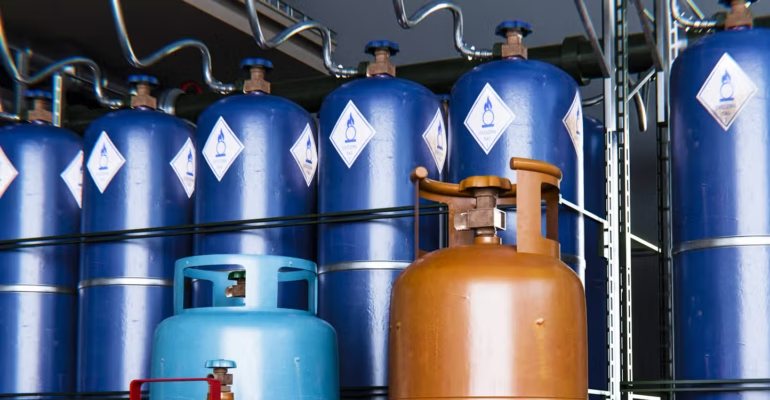
Dr Leopold Oscar Nelwan, a lecturer in Mechanical and Biosystems Engineering at IPB University, commented on the plan to replace 3 kilogram liquefied petroleum gas (LPG) cylinders with compressed natural gas (CNG).
He noted that this initiative has the potential to support national energy security. However, its implementation requires a comprehensive assessment of technical, economic, and safety aspects, as well as infrastructure readiness, to ensure the program runs effectively and safely for the public.
“The use of CNG as a substitute for LPG is technically feasible because Indonesia has abundant natural gas resources,” he said.
Nevertheless, he continued, the program’s success depends not only on gas prices but also on the readiness of storage and distribution technologies, as well as supply chain management.
“This idea is worth exploring because Indonesia still imports large quantities of LPG. If domestic natural gas can be utilized optimally, dependence on imports and the government’s subsidy burden could potentially be reduced,” he said.
The Difference Between LPG and CNG
Dr Leopold explained that natural gas has different characteristics from LPG. Natural gas is predominantly methane, while LPG consists of propane and butane. These differences in properties mean that their storage and distribution systems also differ.
Natural gas cannot be liquefied at ambient temperatures simply by increasing pressure. Therefore, CNG must be compressed to approximately 200–250 bar so that the volume of gas stored in the cylinder is sufficient to meet household needs.
These conditions mean that implementing CNG requires additional investment in compression facilities, high-tech cylinders, specialized regulators, and modifications to stoves.
“So the main challenge lies not in the type of gas itself, but in the storage technology, infrastructure, and supporting systems,” he explained.
Is CNG More Dangerous?
Addressing public concerns about the high pressure in CNG cylinders, Dr Leopold noted that such concerns are understandable. CNG is indeed stored at much higher pressures than LPG, so the cylinder design and safety systems must be specifically engineered for these conditions.
“CNG safety is determined not only by the cylinder’s ability to withstand pressure but also by its ability to prevent and control leaks. Therefore, the design and construction of the cylinders, the quality of materials and manufacturing processes, valves and connections, regulators, and other safety devices must meet strict requirements. Testing, certification, and periodic inspections are also crucial to ensuring the system’s integrity during use,” he said.
In the Event of a Leak
Dr Leopold explained that in the event of a leak, the characteristics of the gas must also be taken into account. Methane, as the primary component of natural gas, has a lower density than air, so in open spaces it tends to rise and disperse. However, this does not mean that leaks can be ignored.
“In enclosed spaces with inadequate ventilation, methane can still accumulate under certain conditions and form a flammable mixture. Therefore, ventilation, leak detection, and safety systems remain critical components in the use of CNG,” he emphasized.
This differs from LPG, which is generally heavier than air, so leaked gas tends to accumulate at the bottom or in low-lying areas of enclosed spaces. Consequently, both CNG and LPG require appropriate storage, installation, ventilation, and handling systems to control the risk of leaks.
Supporting the Energy Transition
From an environmental perspective, Dr Leopold noted that natural gas produces lower carbon emissions compared to coal and is generally slightly lower than LPG for the same amount of energy. However, he cautioned that natural gas remains a fossil fuel and therefore cannot be categorized as renewable energy.
He believes that the use of CNG can be part of the energy transition if the savings from reduced subsidies are genuinely allocated to accelerate the development of renewable energy, such as solar power, wind power, energy storage systems, and the strengthening of the national power grid.
According to him, Indonesia has extensive experience with various energy conversion programs. This experience should serve as a lesson for the implementation of CNG in households.
“Implementation should be carried out gradually, starting with regions or user groups where the infrastructure is supportive, for example, those that already have a gas distribution network or are located relatively close to a gas source. In the initial phase, aspects such as safety, supply reliability, infrastructure and cylinder readiness, adjustments to cooking equipment, and public education need to be thoroughly tested and evaluated before the program is expanded,” he advised.
DME: An Alternative Solution
Dr Leopold said that, in addition to CNG, other alternatives such as dimethyl ether (DME) also need to be evaluated objectively. DME has storage and distribution characteristics that are more similar to LPG, so it has the potential to utilize some of the existing infrastructure and systems.
However, the large-scale development of fuel-grade DME for household use also requires production readiness, raw material availability, infrastructure, and a thorough economic feasibility study.
“Therefore, CNG should be viewed as one option, not as the only solution. Before widespread implementation, an objective comparative study of various alternatives, including DME and the expansion of the city gas network, is necessary,” Dr Leopold emphasized.
This comparison must cover safety, cylinder design and service life, infrastructure readiness and requirements, investment and distribution costs, energy prices for the public, supply reliability, environmental impacts, and long term benefits for Indonesia’s energy security and transition.
“A phased approach based on the results of field tests and evaluations will allow decisions regarding the implementation of CNG to be made more carefully, based on evidence, and in accordance with the conditions of each region,” he concluded. (dr) (IAAS/WSG)