
Indonesia Exports Long Tailed Monkeys, Here’s the Response from an Ecological Geneticist at IPB University
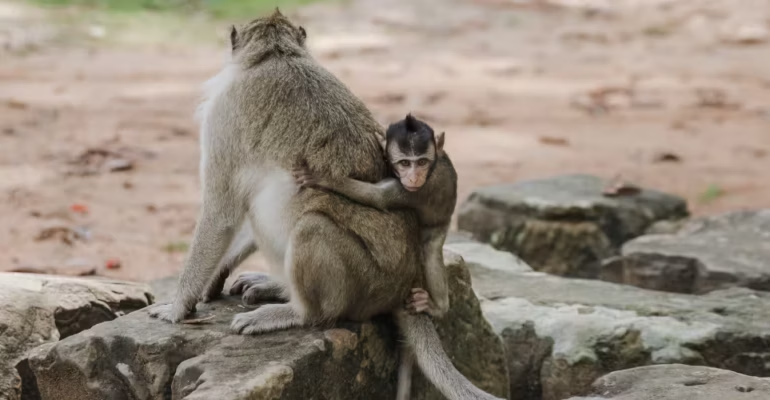
Indonesia once again exported 1.928 long tailed macaques in June 2026, following its last export in 2022. This export is undoubtedly driven by the price of macaques for research purposes, approximately US$3.000–US$4.000 per animal with the United States (U.S.) and China serving as the primary markets.
According to Prof Ronny Rachman Noor, an expert in ecological genetics at IPB University, from a legal standpoint, Indonesia’s monkey exports are considered lawful because they are regulated under the quotas of the Convention on International Trade in Endangered Species of Wild Fauna and Flora (CITES).
“Another reason, of course, relates to the significant foreign exchange earnings driven by high demand from the US and China for biomedical research. “The government argues that monkeys from breeding facilities in Lampung and Tinjil Island are not the result of wild capture, so they do not threaten natural populations,” he said.
Sparking Controversy
According to Prof Ronny, Indonesia’s decision to resume exports of long-tailed macaques has sparked controversy because it relates to the species’ endangered status.
“It’s important to remember that according to the IUCN (International Union for Conservation of Nature), the conservation status of the long tailed macaque is listed as ‘Endangered,’ and its population is projected to decline by 40 percent over three generations due to habitat loss and trade,” he explained.
Prof Ronny believes this decision will damage Indonesia’s international reputation because it runs counter to the global trend of avoiding the use of primates in research. The availability of alternative methods has led many developed countries to strive to avoid using primates for research.
“From a scientific and evolutionary perspective, long tailed macaques are intelligent, social creatures that have the right to live freely in the wild. Their use as test animals violates animal rights and, of course, invites widespread criticism because it is seen as a failure to protect endangered wildlife,” stated Prof Ronny.
The most critical issue, according to Prof Ronny, is that this export has the potential to fuel illegal trade, as the scheme for purchasing monkeys from local communities may involve illegal capture, which is then concealed and processed at breeding facilities. Furthermore, the processes of capture, transportation, and research often cause physical and psychological suffering to the animals.
Many Non-Animal Alternative Methods
Prof Ronny explained that alternative methods for testing drugs, cosmetics, and other research without involving monkeys are already available and developing rapidly. For example, in vitro tests using human cells or artificial tissues to assess toxicity, skin irritation, and drug effects. Similarly, 3D human skin models are already available for cosmetic research.
“Since 2013, the European Union has banned cosmetic testing on animals, thereby driving the development of alternative methods. The European Union and the United Kingdom have already shifted to NAMs such as organ-on-chip and AI (artificial intelligence). Organ-on-chip technology can simulate human organ functions on a miniature scale, making the results more relevant than tests using monkeys,” he explained.
Technological advancements have also occurred in computer modeling and AI (in silico), which can perform digital simulations to predict drug molecule interactions. Additionally, AI accelerates the analysis of thousands of compounds without the need for experiments on laboratory animals.
High-throughput screening (HTS) technology has also been developed using robots and automation to rapidly test thousands of compounds in cell cultures, thereby accelerating drug discovery without the use of animals.
Furthermore, methods using stem cells and iPSCs derived from human stem cells can be developed into various tissues, thereby enabling the direct testing of drug effects on human biological systems without using laboratory animals such as monkeys.
“In addition to being developed to reduce animal suffering, these various alternative methods are more efficient, cost effective, and can be conducted on a large scale,” he said.
Monkey Exports Must Be Stopped
For Prof Ronny, the export of long tailed macaques is not merely an economic issue, but also one of ethics, conservation commitment, and Indonesia’s reputation. Halting these exports will affirm Indonesia’s moral leadership in protecting wildlife while aligning with the trend toward more humane scientific practices.
“To maintain its international reputation, Indonesia must reduce its reliance on foreign exchange earnings from monkey exports. This move to halt the export of long tailed monkeys will certainly improve Indonesia’s international reputation and image, as it demonstrates Indonesia’s support for cutting edge research that does not use laboratory animals, while also showcasing its commitment to protecting animal rights,” concluded Prof Ronny. (*/Rz) (IAAS/LAN)

