Floaters Are Not Caused by Gadget, an IPB University Ophthalmologist Explains the Causes and Warning Signs
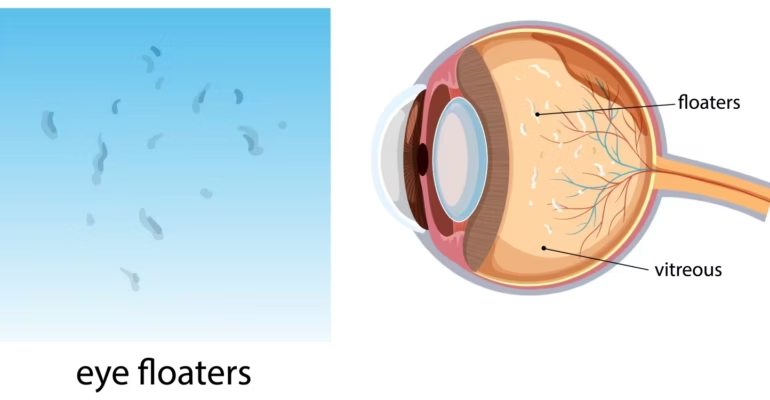
Recently, there has been widespread public discussion about complaints of black shadows, small dots, threads, or spiderwebs floating in one’s field of vision, commonly known as floaters.
This condition is often linked to prolonged use of gadgets or electronic devices. However, dr Drasthya Zarisha, SpM, an ophthalmologist and lecturer at IPB University, emphasizes that this assumption is not entirely accurate.
According to her, floaters are a symptom generally caused by clusters of microscopic collagen fibers in the vitreous gel, the gel that fills most of the eyeball’s cavity. These clusters of fibers cast shadows on the retina, causing a person to see black spots, threads, or spiderwebs that appear to follow the direction of their gaze.
“In most cases, floaters occur as a natural process associated with aging. The vitreous gel undergoes liquefaction and shrinkage, resulting in shadows that become visible when the eyes move,” she explained.
In addition to the aging process, a history of eye trauma can also trigger the appearance of floaters. In some cases, this symptom may be caused by bleeding within the vitreous gel or a retinal disorder that requires medical treatment.
It’s Not Because of Gadgets
dr Drasthya also debunked the notion that gadget use is the main cause of floaters. She explained that prolonged use of digital devices does not directly cause this condition.
“Using gadgets for too long without a break can indeed cause the eyes to tire quickly. As a result, a person becomes more aware of or bothered by floaters that were already present,” she said.
Although it is generally a normal condition, people should remain vigilant if floaters appear suddenly, increase rapidly in number, or are accompanied by flashes of light (photopsia), especially at the periphery of their vision. These symptoms may indicate a retinal disorder that requires immediate examination.
She advises anyone experiencing floaters for the first time or whose symptoms are becoming increasingly bothersome to see an ophthalmologist immediately. An examination of the retina, optic nerve, and vitreous gel is essential to ensure there are no abnormalities requiring further treatment.
Furthermore, dr Drasthya explained that the risk of developing floaters is higher among older adults, people with myopia, especially those with high myopia, individuals with a history of eye surgery or certain conditions affecting the lens, as well as those with a family history of or a personal history of retinal detachment.
“Early detection is key to preventing more serious retinal disorders. Therefore, don’t hesitate to have your eyes checked if you notice any unusual symptoms,” she concluded. (Lp) (IAAS/FHD)