
Visiting Farmers in Cikarawang, IPB University Expert Stresses the Importance of Maintaining Soil Health
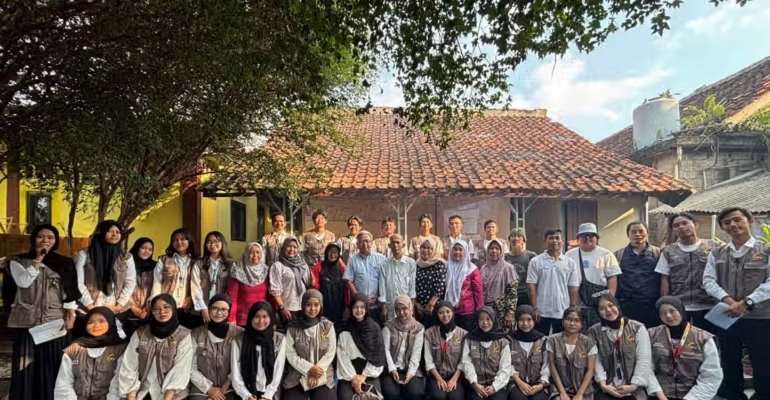
“Up until now, we’ve tended to focus more on feeding the plants, when in fact we also need to maintain the health of the soil,” said Prof Arief Hartono, Professor of Soil Science at the Faculty of Agriculture, IPB University, during a meeting with farmers in Cikarawang Village, Bogor Regency, West Java.
Speaking before dozens of farmers from Cikarawang Village, he reminded them that the current challenge in agriculture is not merely pursuing higher crop yields, but shifting away from overreliance on chemical fertilizers which damage the soil toward the use of functional organic fertilizers made from local waste.
“If the soil is healthy, plants will grow better and productivity can be sustained in the long term,” he said.
Prof Arief made this statement during a “Focus Group Discussion (FGD) on Community Awareness of Food and Plant Nutrition” organized by the Student Executive Board Student Association (BEM KM), with support from the Institute for Agromaritime Development and Innopreneurship Acceleration (LPA2I) at IPB University.
Held at the Mandiri Jaya Farmers Group (Gapoktan) in Cikarawang Village, Dramaga Subdistrict, Bogor Regency, this event served as a forum for members of the Setia Farmers’ Group, the Hurip Farmers’ Group, the Melati Women Farmers Group (KWT), and the Dahlia Women Farmers’ Group (KWT) to discuss the real challenges faced by local farmers.
The event began with a “cucurak” session designed to foster camaraderie among participants, organizers, and speakers, followed by a seminar, focus group discussions (FGDs), and other discussions.
As a solution for soil improvement, Prof Arief introduced liquid organic fertilizer (POC), which communities can produce on their own. This fertilizer can be made by utilizing organic waste such as vegetable scraps, fruit scraps, livestock manure, and other organic materials available in the local environment.
“The raw materials are actually all around us. What’s needed is a proper understanding of the fermentation process so that microorganisms can work optimally and produce high quality fertilizer. This method not only reduces production costs but also minimizes waste while improving soil quality,” he explained.
The FGD session also served as a forum for participants to identify various agricultural issues in Cikarawang Village while exploring potential resources that could be utilized as raw
materials for alternative fertilizers. Participants shared the various challenges they face in the field, ranging from limited access to subsidized fertilizer and declining soil quality to the difficulty of utilizing organic waste as an alternative fertilizer.
In response, Prof Arief emphasized that each region has different potential, so agricultural solutions must also be tailored to local conditions.
“Not all problems need to be solved by purchasing inputs from outside. The local potential found in villages can actually be the solution if managed with the right knowledge and innovation,” he said.
At the end of the session, Prof Arief encouraged the community to continue building collaborations with the government, universities, and various stakeholders so that the resulting solutions are not only technical in nature but also supported by appropriate policies. (*/Rz)(IAAS/ST)

