Ahead of IPB University’s 2027 Re-Accreditation, Rector Calls on Faculties and Schools to Strengthen Quality Management
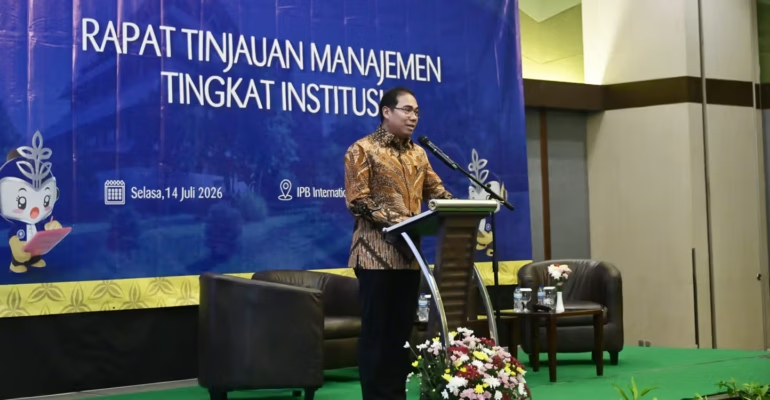
The Rector of IPB University, Dr Alim Setiawan, has called on all faculty and school leaders to strengthen their quality management systems as part of getting ready for institutional accreditation, which will take place in 2027.
He said this at the Institution Level Management Review Meeting (RTM), held by IPB University’s Quality Management Office (KMM) at the IPB International Convention Center (IICC), Bogor, on Tuesday (7/14). The event was attended by deans, vice deans, heads of institutes, and unit leaders across IPB University.
According to the Rector, the RTM is an important moment to review how well the quality assurance system has been working, and to plan improvement steps as part of an ongoing quality improvement cycle.
“Administratively, this review is very important because next year we start preparing for the university’s accreditation. IPB’s institutional accreditation will end in November 2027, so the preparation and document submission process must be done well ahead of time,” he said.
At the event, the Rector also asked every faculty and school to quickly set up a Quality Management and Accreditation Commission. So far, only eight faculties and schools have formed one.
According to him, having a Quality Management and Accreditation Commission is very important for strengthening quality governance, while also reducing the workload on individual study programs during the accreditation process.
“We want accreditation to no longer be only the burden of study programs, but to be strengthened at the faculty and school level, with support from the Quality Management Office,” he said.
Meanwhile, the Chairman of IPB University’s KMM, Dr I Wayan Nurjaya, said the RTM plays an important role in making sure all the quality indicators required for accreditation are met.
Through the RTM, he said, institution leaders can identify indicators that have not yet met the standard, then agree together on a plan for continued improvement.
“We hope that at the next RTM, the number of issues found will keep going down, or even disappear completely,” he said.
He added that the Institution Level RTM also aims to bring all work units to a shared understanding and commitment toward the institution’s quality goals, while lining up the improvement programs needed to boost the organization’s performance and support a successful institutional accreditation.
He continued that holding the RTM is not just part of the setting standards, implementing, evaluating, controlling, and improving (PPEPP cycle), but is also a strategic tool to strengthen a culture of quality and improve IPB University’s competitiveness, both nationally and internationally. (dh)(IAAS/ST)