Through KOICA-ICAB, IPB University and SNU Strengthen the Capacity of Animal Cell Culture Researchers
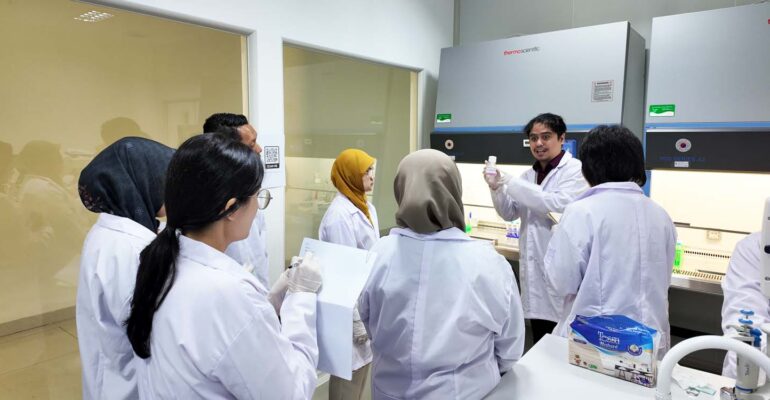
IPB University, in collaboration with Seoul National University (SNU) through the IPB-SNU Center for Agriculture and Bioscience (ICAB) project, organized a training session titled “Fundamental Techniques in Mammalian Cell Culture” as part of efforts to strengthen human resource capacity and develop the animal cell culture research ecosystem on campus.
This training is part of the ICAB project supported by the Korea International Cooperation Agency (KOICA). This support includes the development of laboratory infrastructure and the enhancement of researchers’ capabilities at IPB University. The training program has consisted of four sessions since the IPB University Animal Cell Culture Laboratory was inaugurated on September 23.
This training session covered various basic techniques in mammalian cell culture, including cell thawing and seeding, cell observation, medium change, cell harvesting, and cell freezing. The training was initiated by ICAB under the supervision of Prof Tae Sub Park, a professor in the field of animal genetic engineering from the Graduate School of International Agriculture Technology (GSIAT) at SNU. After Prof Tae Sub Park completes his sabbatical leave at IPB University in 2025, the training program will be continued by the IPB University animal cell culture team consisting of Dr drh Mawar Subangkit, Dr Inda Setyawati, and Rafianto Dwi Cahyo, MEng.
This program is attended by faculty members from various faculties and schools at IPB University, including the School of Veterinary and Biomedical Sciences, the Faculty of Fisheries and Marine Sciences, the Faculty of Animal Science, the Faculty of Forestry and the Environment, the Faculty of Engineering and Technology, the Faculty of Mathematics and Natural Sciences, and the Faculty of Medicine.
This training will also synergize with the development of the National Instrumentation Center for Agriculture and Bioscience (NICAB), which will house five flagship laboratories, namely cell culture, metabolomics and natural products, molecular science, nano-imaging, and agromaritime material characterization.
Through the strengthening of these facilities and researchers’ competencies, IPB University hopes to encourage the emergence of more animal cell culture research while strengthening Indonesia’s contribution to the development of modern life sciences, biotechnology, and bioscience. (*/Rz) (IAAS/FHD)