To Promote Economic Self Reliance Among Participants of the Quality Family School Program, IPB University Provides Training Ranging from PATEN Practices to Halal Certification
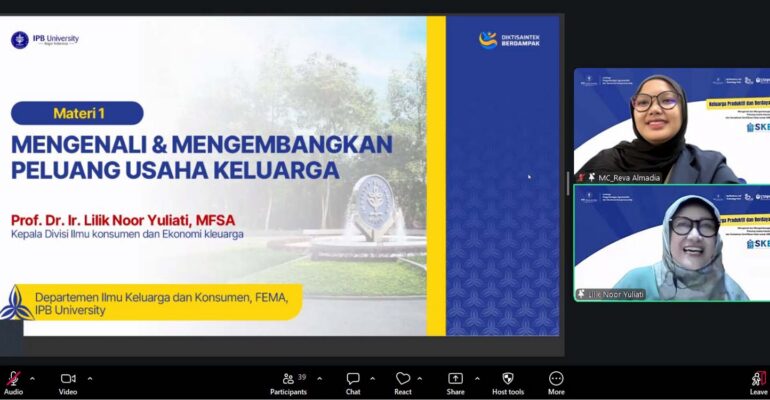
The Institute for Agromaritime Development and Innopreneurship Acceleration (LPA2I) at IPB University hosted a webinar titled Productive and Empowered Families. This event is part of the Quality Family School (SKB) program, which aims to equip families with business development strategies.
Dr Handian Purwawangsa, Chairman of LPA2I at IPB University, stated in his opening remarks, “Strengthening the role of the family is key to promoting economic independence and optimizing business opportunities in the local community.”
He noted that this event is a concrete example of IPB University’s contribution to supporting science based community empowerment through experts presenting their knowledge in the form of educational materials.
Professor of Family and Consumer Sciences at IPB University, Prof Lilik Noor Yuliati, introduced the practical PATEN analysis approach (market potential, competitor analysis, trends, evaluation, and unique value).
“Family businesses play a strategic role in supporting a sustainable economy, both at the household level and within the broader community. Therefore, the PATEN analysis is crucial to ensure that the businesses are more focused and competitive,” explained Prof Lilik.
Next, Syifa Damaianti Suwandi, the Product Development Lead for SMEs at LPA2I, delivered a comprehensive presentation on halal certification. She covered the application process, the necessary steps involved, and the benefits of halal certification in enhancing consumer trust and product competitiveness in the market.
Not only that, but the interactive discussion session also facilitated direct interaction between participants and the presenters. The participants, most of whom were homemakers and heads of households, actively asked questions and shared experiences regarding the opportunities and challenges in developing family businesses. (*/Rz) (IAAS/HNY)