
Signing MoU, IPB University and A’en Murtic Zaya Group Ltd Push Waste Management Based Regenerative Economy
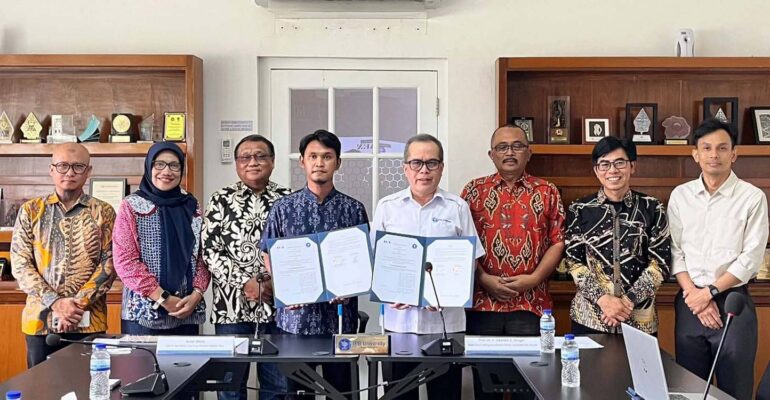
IPB University signed a Memorandum of Understanding (MoU) with A’en Murtic Zaya Group Ltd to develop a regenerative economy through waste management and sanitation. This collaboration is led to present continuous solutions that not only decrease waste, but also to invent economic value and restore the environment.
Vice Rector for Global Connectivity, Cooperation, and Alumni of IPB University, Prof Iskandar Z Siregar states that waste and sanitation issues need to be handled collaboratively. “Waste and sanitation became the main issue that we need to push together through communication and cross sector cooperation,” he said.
He explains that the living laboratory concept that is being developed by IPB University becomes an active room of innovation implementation. “Living Lab is a place where we do not talk about theory anymore, rather directly produce solutions on the field,” he said. This approach integrates the food aspect, energy, and water in the Sustainable Development Goals (SDGs) framework.
According to Prof Iskandar, regenerative economy became the key because it did not stop at waste management, but also restored the ecosystem and strengthened the production system. One of the examples is land revitalization post-mine that becomes a productive area that includes agriculture, fishery, and animal husbandry.
A’en Murtic Zaya Group Ltd Main Director, A’enul Ghury, mentioned MoU as a strategic step in building a new economic system, “We view this collaboration as a strategic step to speed up regenerative economy implementation that gives real impact for the environment and society,” he said.
He explains that this regenerative economy model has been implemented at Batur Village, Semarang Regency, Central Java. Waste that has been thrown fully before to the landfill is now being managed into compost, animal food, and alternative fuel, until it is left only with residue. “We saw farmers there utilize the result of compost that we produced. That became a real contribution that is different compared to other places,” he said.
Besides that, A’en Murtic Zaya Group Ltd also develops digital application hijao.id to support integrated waste management systems. This platform connects society, management, and industry in selection process, collection, up to waste management, empowering regenerative economy ecosystems based on data and public participation.
Through this collaboration, both parties are committed to expanding the regenerative economy to various regions, while also speeding up transition from a linear economy into a system that is more sustainable and impactful for society. (Fj)(IAAS/PRO)

