
IPB University Students Bring Innovation to Timor Leste through International KKN
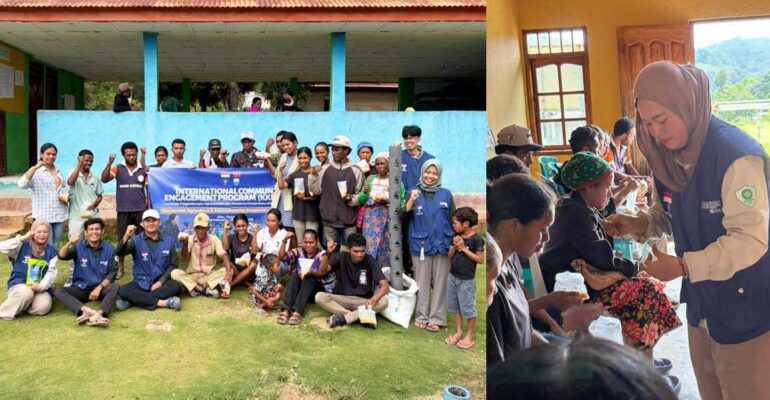
Ten IPB University students participating in the International Real Work Lecture (KKN) in Timor Leste brought various innovations to strengthen community capacity in agriculture, fisheries, and climate change.
Held from February 26 to March 13, 2026, in Aileu, Timor Leste, this program aims to strengthen community capacity in facing food production and climate change challenges.
In the agricultural sector, activities focused on developing vertical gardens and utilizing Trichoderma, an antagonistic fungus that plays an important role as a biological agent to increase plant productivity and health.
“This fungus can be used as a biological fertilizer and natural biofungicide that can help control various plant diseases,” explained Yosafat Dimas Anandita, one of the student representatives, when introducing Trichoderma propagation technology to the Aileu community on Thursday (3/5).
He added, “Trichoderma can help suppress the growth of pathogenic fungi that cause root diseases such as fusarium, rhizoctonia, and phytophthora. This fungus is also capable of stimulating root growth, accelerating the decomposition of organic matter in the soil, and increasing plant resistance to various environmental stresses.”
Field supervisor Wildan Nurussalam, SPi, MSi, added that international real work lecture students in Timor Leste also developed an aquaponics system, tilapia masculinization technology, and the use of probiotics in fish feed.
“As a form of adaptation to climate change, the IPB team will also install an Automatic Weather System (AWS) to support weather monitoring and improve community preparedness for climate dynamics,” he added.
The local village chief, Felisberto, expressed his appreciation for the activities carried out by the students. “The program brought by IPB students is very beneficial for the community. We hope that this kind of knowledge can continue to be developed because it can help farmers implement healthier and more sustainable agricultural practices,” he said.
Previously, the International KKN team was officially welcomed by the Indonesian Embassy in Dili on Wednesday (2/26). The Indonesian Ambassador to Timor Leste, Okto Donirus Manik, welcomed and appreciated the presence of IPB students in Timor Leste.
According to him, this activity demonstrates IPB’s commitment to expanding its contribution to agricultural and fisheries development to the international level. He advised the students to come up with innovations that add value to local products, such as the development of fish based processed foods, which are still limited in Timor Leste, so as to increase the economic value of the community.
Chairperson of Economic and Technical Cooperation at the Indonesian Embassy in Dili, Banga Malewa, added that Indonesia’s role in Timor-Leste is very strategic, with around 34 percent of products circulating in the country originating from Indonesia. In addition, a number of Indonesian state-owned enterprises are also working on various strategic infrastructure projects, such as the construction of highways and airports.
“We appreciate IPB’s initiative in carrying out community service in Timor-Leste. We are ready to provide support if needed,” she said, emphasizing her commitment.
Both IPB University and the Indonesian Embassy in Timor-Leste hope this program will have a positive and sustainable impact on the community of Aileu and strengthen cooperation between Indonesia and Timor-Leste in the fields of agriculture, fisheries, and sustainable development. (*/Rz) (IAAS/DON)

