IPB University Forestry Expert Reveals Principles of Sustainable Forest Harvesting from an Islamic Perspective
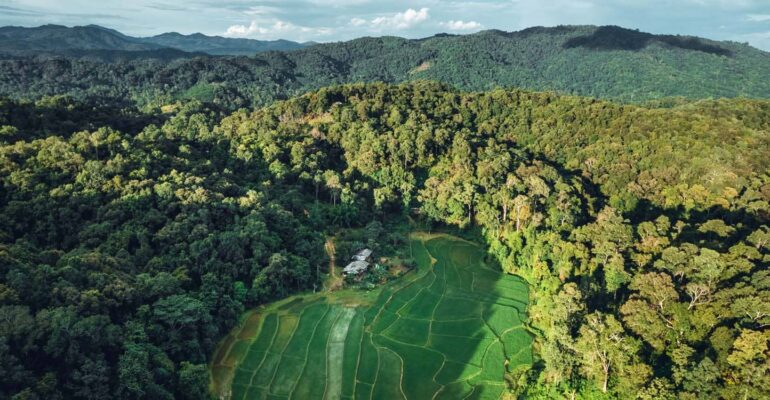
The destruction of ecosystems and natural disasters plaguing the Earth are not events without cause, but rather the consequences of human behavior that exploits nature beyond its limits.
This was emphasized by IPB University Forestry Expert, Prof Ahmad Budiaman, during a Morning Lecture titled “Sustainable Forest Harvesting from an Islamic Perspective” at the Al Hurriyyah Mosque, IPB University, Thursday (3/5).
“The Qur’an explicitly warns in Surah Ar-Rum verse 41 that corruption has appeared throughout the land and sea because of what the hands of people have earned. Allah does not like destructive actions that contradict the principles of balance,” stated the lecturer from the Faculty of Forestry and Environment, IPB University.
According to Prof Ahmad, Islam teaches the principle of ‘sufficiency’ as the primary foundation for utilizing natural resources. Humans are commanded to take only what is necessary and are strictly forbidden from excessively exploiting the environment.
Furthermore, he emphasized the importance of the selective principle in harvesting. This is reflected in the warning of the Prophet Muhammad, (PBUH), who strictly forbade the unjust felling of the bidara tree, given that the tree provides extensive ecological benefits to various living creatures.
Even in conditions of war, which are synonymous with destruction, Islam still establishes very strict ethical boundaries regarding nature. “The Prophet (PBUH) explicitly forbade his troops from destroying date palm groves and cutting down trees except under absolute necessity.”
“This reflects that nature must be respected, and its utilization must not be carried out haphazardly,” he explained.
Moreover, Prof Ahmad explained that the sustainability of forests is an intergenerational mandate. Therefore, Islamic teachings do not only regulate the ethics of taking but also mandate restoration (reforestation) after utilization.
“Islam highly values replanting efforts. There is even a hadith stating that if the Day of Judgment begins while one of you has a seedling in their hand, they should still plant it,” he elaborated.
Every tree planted that provides benefits to other creatures will be recorded as charity (sadaqah). He asserted that the practice of cutting down one tree should ideally be replaced by planting several new seedlings as a form of ecological responsibility.
Protecting forests, he added, is not merely an option but a moral and spiritual obligation for Muslims. Through the application of the concept of balance and utilizing only what is sufficient, he hopes that forests can remain sustainable and provide benefits for both current and future generations. (*/Rz) (IAAS/HNF)