
Indonesia Boasts 1.000 Islamic Economics Study Programs, Prof. Irfan Syauqi Beik: Must Be Balanced with Quality
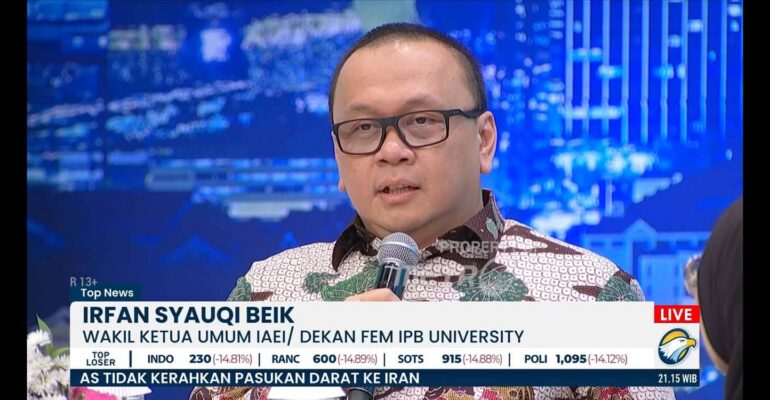
Indonesia possesses significant potential to become the global hub for the Islamic economy. However, this potential has not been fully optimized as the primary challenge remains the quality of human resources (HR).
Prof Irfan Syauqi Beik, Dean of the Faculty of Economics and Management at IPB University and Vice Chairman of IAEI, emphasized that the Islamic economy encompasses three main pillars: the real sector (halal industry), the financial sector, and the social sector (Ziswaf). These three sectors require the support of competent and competitive human resources to achieve sustainable growth.
As a primary driver, the real sector still faces a significant gap between industrial needs and the availability of experts. This persists despite the fact that halal industry sectors such as food, tourism, and fashion require a massive workforce.
In the Islamic financial sector, competitiveness challenges still overshadow graduates who strictly specialize in Islamic economics. Currently, approximately 60 percent of the workforce in the Islamic industry actually comes from general economics backgrounds.
Prof Irfan also highlighted that although Indonesia has nearly 1.000 Islamic economics study programs, this quantity must be balanced with strengthened quality and ethical mindsets.
“The number of Islamic economics study programs has reached nearly 1.000, the highest in the world, but it must be balanced with quality,” he stated. Without the formation of the correct mindset, a wide gap will emerge between academic theory and field practice.
The optimization of the social sector, particularly zakat and waqf (endowments), was also highlighted as management has not reached its full potential. Prof Irfan explained that productive waqf assets currently stand at only about 9 percent. Yet, if managed effectively, they could become an extraordinary source of funding.
To overcome these obstacles, he proposed a triple helix collaboration between academia, industry, and the government. Universities are expected to transform into producers of innovation, centers for public literacy, and drivers of research that impacts national policy.
“Universities must become producers of innovation and impactful centers of public literacy,” he added, emphasizing the role of academics in supporting national development targets.
Indonesia itself has become a global reference in research based innovation, such as through the blended finance model in cash waqf linked sukuk. Prof Irfan believes that with supportive regulations and cross-ministerial synergy, Indonesia is capable of dominating the global halal market, which is currently still controlled by non-muslim countries.
“We need consolidation and synergy to optimize the potential of the global halal market. By strengthening competent human resources who are resilient to economic shocks, Indonesia will not only be a domestic player but will truly become the epicenter of the global Islamic economy,” he concluded. (MW) (IAAS/HNF)

