Groundbreaking NICAB: IPB University and KOICA Build Global Standard Agromaritime Research Instrumentation Center
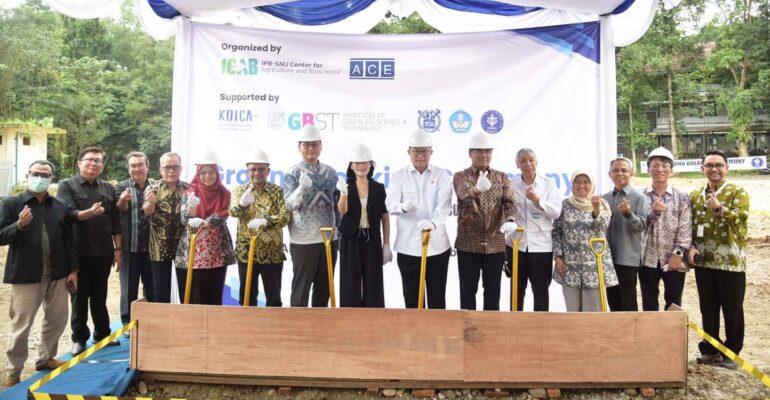
IPB University has officially begun construction of the National Instrumentation Center for Agriculture and Bioscience (NICAB). This momentum marks a new chapter in strengthening Indonesia’s agromaritime and bioscience research towards global standards.
NICAB is a core part of the KOICA-ICAB project (2022–2028) supported by the Korea International Cooperation Agency (KOICA) in collaboration with IPB University and Seoul National University (SNU). The building is targeted for completion in 2027 and is projected to be an international standard laboratory with a modern support system.
During the NICAB Kick-Off Ceremony and Groundbreaking at the IPB Dramaga Campus (2/26), IPB University Rector Dr Alim Setiawan Slamet emphasized that the construction of NICAB is not merely a physical project, but a strategic institutional step.
“Today is not just about building a new structure. We are laying the foundation for a new era of excellence in research, scientific collaboration, and innovation that will have an impact on global society,” he said.
According to him, NICAB is a tangible manifestation of KOICA’s trust and commitment to strengthening agricultural and bioscience research capacity in Indonesia. This center is designed as the foundation of an integrated research ecosystem to address national challenges, ranging from the limited availability of skilled human resources, laboratory management, to the low utilization of advanced research equipment.
“We believe NICAB will be a key infrastructure to support more integrated, advanced, and influential research. This facility not only serves IPB, but is also open to national and global collaboration,” he added.
KOICA Indonesia Country Director Kim Hyojin, representing the Ambassador of the Republic of Korea to Indonesia, emphasized that the construction of NICAB at IPB University is part of the strategic partnership between the two countries in responding to global food security challenges.
“NICAB is designed as a scientific platform with five advanced laboratories that will bridge research and field application, so that innovation can provide tangible benefits for farmers and industry. Through NICAB, Korea and Indonesia are strengthening their joint commitment to building a resilient, science based, and future oriented food system,” she said.
Five Leading Laboratories
The NICAB building will house five leading laboratories, namely cell culture, metabolomics and natural products, molecular science, nano-imaging, and agromaritime material characterization. These five laboratories are positioned as pillars of IPB’s future research ecosystem, aligned with national priorities such as food security, sustainability, and the development of bioscience based on biological resources.
Vice Rector for Research, Innovation, and Agromaritime Development, Prof Ernan Rustiadi, places NICAB as part of IPB University’s vision to achieve global leadership in the agromaritime field.
“We have established four research pillars: omic science, artificial intelligence, sustainability science, and socio-economics. NICAB will strengthen the integration of these pillars within the agromaritime framework,” he explained.
According to Prof Ernan, the collaboration with KOICA symbolizes IPB University’s global connectivity, including with Global South countries in Africa, South America, the Caribbean, and the Pacific. “We don’t just want to be leaders in Southeast Asia, but also global players in agromaritime,” he emphasized.
Meanwhile, KOICA-ICAB Project Manager Prof Ho Sang Kang explained that the idea for the development of NICAB stemmed from the urgent need for research facilities that truly meet international standards.
“When I came to IPB University in 2022, I saw a lot of advanced research. However, the facilities did not fully support advanced research equipment. Good equipment requires a highly controlled environment, humidity, air circulation, and cleanliness levels,” he said.
He added that NICAB was designed as a model laboratory with modern support systems to ensure that high-tech instruments can function optimally. This facility will strengthen biotechnology, including cell culture such as stem cell technology, molecular biotechnology, and agromaritime material analysis through high precision nano imaging.
“Indonesia possesses immense biological resources. However, without robust analytical capabilities, this potential cannot be fully realized. NICAB will bridge that gap,” he concluded. (AS) (IAAS/HLF)