
Environmentally Friendly Wood Composites Created by IPB University Innovators Make it to 117 Indonesian Innovations 2025
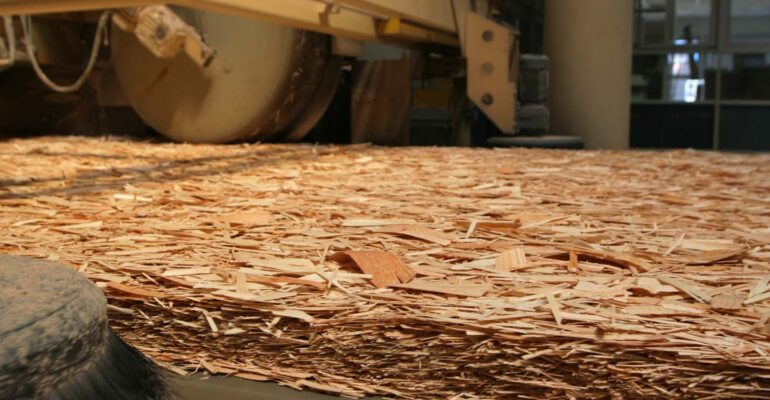
Composites are combined materials designed to produce stronger and more stable properties. In the wood industry, composites are widely used for panels such as plywood, oriented strand board (OSB), medium density fiberboard (MDF), and particle board, which currently still rely on formaldehyde and isocyanate based adhesives that pose risks to health and the environment.
In response to this issue, researchers at IPB University have developed a safe and environmentally friendly wood composite. This topic was one of the selected innovations in the 117 Indonesian Innovations 2025 event organized by the Business Innovation Center (BIC).
This research was developed by Dr Rita Kartika Sari, a lecturer at the Department of Forest Products, Faculty of Forestry and Environment, together with a team from IPB University, the National Research and Innovation Agency (BRIN), and the University of Lampung.
Data from the Central Statistics Agency in 2025 shows that the second largest roundwood production in Indonesia comes from the acacia genus, particularly mangium wood (Acacia mangium), which accounts for 42,52 percent of the total national roundwood or around 27,57 million cubic meters.
In the process, about 10 percent of the volume is bark, resulting in approximately 2,7 million cubic meters of waste each year. This large amount has high green chemistry potential, as mangium bark is rich in tannins that can be processed into sustainable industrial raw materials.
“From this potential, a synthesis technology and formula for non-isocyanate bio-polyurethane resin based on mangium bark tannins as a formaldehyde free wood adhesive was developed,” explained Dr Rita.
She revealed that, until now, the wood panel industry has relied on urea-formaldehyde and phenol-formaldehyde resins, which have the potential to release formaldehyde emissions, or isocyanate-based polyurethane, which is reactive and poses a risk to workers.
“By modifying mangium bark tannin into biopolyol, this system replaces petrochemical based polyols. The process takes place at a moderate temperature of around 80°C with relatively simple steps using dimethyl carbonate and hexamethylenetetramine as polymer network formers that are safer and lower in risk,” she explained.
The adhesive formula was optimized using response surface methodology. As a result, the resin has a solid content of 58,16 percent, a gelatinization time of approximately 1,07 minutes, as well as good thermal stability and water resistance. This adhesive has the potential to be used in the manufacture of wood composites such as OSB, MDF, plywood, and particle board.
Amidst the push towards a circular economy and the Net Zero Emission 2060 target, this innovation shows that research based on national natural resources can exceed its traditional functions.
“Indonesia’s tropical forests not only provide wood, but also the foundation for safer and more sustainable advanced materials. From local biomass, we can build an industry that is both independent and low in emissions,” concluded Dr Rita. (Fj) (IAAS/KQA)

