
Organisational Structure and Governance Transformation, IPB University Rector Inaugurates 35 New Officials
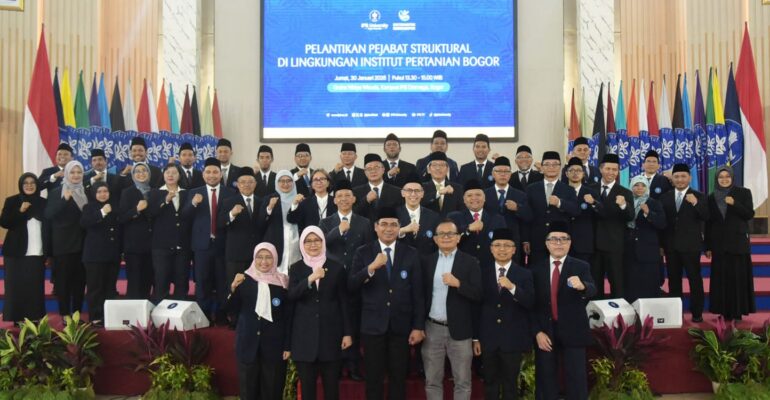
Rector Dr Alim Setiawan Slamet inaugurated 35 new structural officials at IPB University. The inauguration ceremony took place at Grha Widya Wisuda, IPB Dramaga Campus, on Friday (1/30).
In his speech, Dr Alim emphasised that this inauguration was not merely an administrative change of positions, but a strategic moment for the transformation of IPB University’s organisation in facing increasingly complex challenges.
These challenges include technological disruption, global food and health crises, climate change, and increasing demands for sustainable governance and public expectations of the role of higher education.
“We are carrying out this transformation with one main objective, namely to strengthen the relevance, increase the impact, and ensure the sustainability of IPB University as a world-class university that is strongly rooted in the needs of the nation and the future,” said Dr Alim.
The Rector emphasised that the positions held by the new officials are a mandate for transformation that requires adaptive, collaborative, and innovative leadership. The officials are expected not only to carry out organisational routines, but also to be able to deliver breakthroughs and improve the quality of IPB University’s services for all stakeholders.
“This is not just an administrative position. I hope that the officials will be able to build collaboration, dare to innovate, and continue to improve the quality of IPB University’s services,” he said.
Organisational Transformation
On this occasion, the Rector also outlined a number of strategic steps for organisational transformation. First, the merger of the Faculty of Medicine and Nutrition to strengthen the one health and life-course approach paradigms. This integration is expected to encourage the development of integrated medical and nutritional science, based on tropical bioscience, and oriented towards real solutions for the community.
Second, the integration of the Science and Technology Area Institute, the Directorate of Agromaritime Community Development, the Farmer and Fisherman Centre, and IPB Jonggol Innovation Valley. This step aims to strengthen the innovation ecosystem as a whole, from research and technology development, innovation commercialisation, to the empowerment of farming and fishing communities.
“IPB must not operate in a sectoral manner. We must be present as a complete ecosystem that connects laboratories with the field, and innovation with community welfare,” continued the Rector.
Third, the integration of halal functions into the International Research Institute (LRI) for Food, Nutrition and Health, which has now been expanded to become the LRI for Food, Nutrition, Health and Halal. According to the Rector, halal is not just a certification issue, but part of science, health, ethics and global public trust.
Other strategic steps include the establishment of a Campus Security, Safety, and Protection Management Office, as well as the expansion of the Risk Management Office’s functions to become a Governance and Risk Management Office as a manifestation of strengthening good university governance and implementing environmental, social, and governance (ESG) principles.
In addition, IPB University has also expanded the management functions of the Sukabumi Campus, which now not only manages the physical area but also coordinates learning activities in line with the development of the Off-Campus Study Programme (PSDKU).
Closing his remarks, the Rector of IPB University advised the new officials to uphold three core values, namely integrity in governance, courage in innovation, and sensitivity to social impact.
“Organisational transformation will not succeed without collaborative, adaptive leadership that is truly committed to ensuring the welfare of its citizens,” he concluded. (AS) (IAAS/LAN)

