
Kodiklat TNI Partners with Two IPB University Academics to Provide Food Security Training for Soldiers
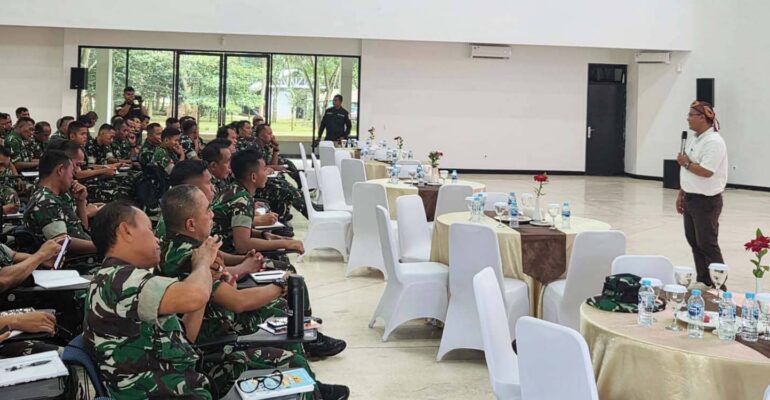
The Doctrine, Education, and Training Command of the Indonesian National Armed Forces (Kodiklat TNI) partnered with two academics from IPB University in the implementation of the 2026 Food Security Technical Guidance (Bimbingan Teknis/Bimtek). The program is designed to enhance the capacity of TNI soldiers and personnel in understanding the complexity of the national food system.
On the first day of the activity, held at the Yos Sudarso Building, Kodiklat TNI, on Monday (2/2), participants received strategic materials on the development of food business ecosystems and sustainable agriculture.
The first speaker, Handian Purwawangsa, Chairman of the Institute for Agromaritime Development and Acceleration of Innopreneurship at IPB University, introduced the One Village One CEO (OVOC) concept, a village assistance model based on entrepreneurial leadership.
“This program places a single driving figure, or village CEO, to orchestrate local potential, manage food commodity value chains, and connect villages with modern markets and industry,” he explained.
The OVOC approach is considered relevant for strengthening food self-reliance at the village level and accelerating the growth of new entrepreneurs in the agromaritime sector. The material presented is expected to broaden participants’ perspectives on modern food security development based on innovation, entrepreneurship, and village empowerment as nodes of the food economy.
Next, Dr Supriyanto, a lecturer in the Agricultural and Biosystems Engineering Study Program, Faculty of Engineering and Technology, IPB University, outlined the urgency of transforming food production systems amid population growth, urbanization, and rising national food demand.
He explained that there are three main platforms for contemporary agricultural production: open-field cultivation, greenhouse/hydroponic systems, and plant factories based on artificial lighting.
“Modern agriculture must prioritize land use efficiency, precision technology, and the application of the latest generation of smart farming,” he said. These concepts include the use of sensors, automation, measured nutrition, and tropical greenhouse designs adapted to Indonesia’s climate.
In addition, participants received materials on horticultural cultivation techniques, the use of mulch, drip irrigation, variety selection, NFT and DWC hydroponic systems, as well as urban farming production strategies such as rooftop farming and vertical farming.
The training series is expected to strengthen TNI’s capacity for independent food provision, increase productivity of horticultural commodities, and encourage the growth of modern food business models within communities.
With the support of academics from IPB University, participants are expected to adopt scientific, innovative, and collaborative approaches in managing food security programs within their respective units.
The activities combine theoretical and practical methods, including training in liquid organic fertilizer production, development of community-based food enterprises, and supply chain management simulations. (*/Rz) (IAAS/KAL)

