
IPB University Encourages Villages to Develop Cooperatives and Sustainable Business Ecosystems
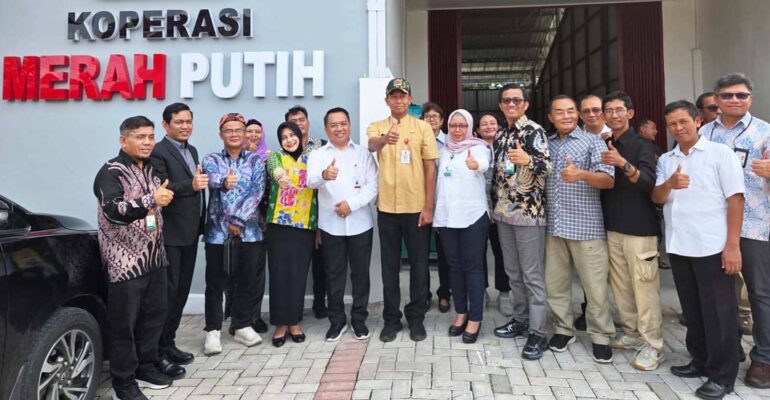
IPB University continues to encourage villages across Indonesia to develop cooperatives and sustainable business ecosystems. The Chairman of the Institute for Agromaritime Development and Acceleration of Innopreneurship (LP2AI) at IPB University, Dr Handian Purwawangsa, stated that there are three main pillars required to realize this goal.
“Strong products, relevant innovation, and open market access are the three key factors for cooperatives and village business ecosystems to grow sustainably,” said Dr Handian during A coordination meeting to prepare for the operational launch of the Merah Putih Village/Subdistrict Cooperative (KDKMP) in Semarang, recently.
The coordination meeting was organized by the Ministry of Cooperatives in collaboration with the Central Java Provincial Office of Cooperatives and MSMEs. On this occasion, Dr Handian, representing IPB University, presented material entitled “OVOC: One Village One CEO – Optimizing Village Business Ecosystems through Strengthening Products, Innovation, and Markets.”
Dr Handian emphasized that the success of the OVOC model does not rely solely on the presence of a village CEO figure, but must be grounded in clear product development, continuous innovation, and strong market access.
“Village products must be standardized, differentiated, and able to economically represent local potential. In this way, cooperatives become centers for consolidating quality and quantity,” he stressed.
Innovation in technology, production processes, business models, and digitalization is also an urgent necessity for village products to remain competitive. OVOC encourages each village CEO to serve as an adaptive engine of innovation.
The final crucial pillar is market access, as village businesses cannot grow without market connectivity. “Partnerships with offtakers, strengthening village branding, and integration with digital platforms are essential to expanding sales reach,” Dr Handian explained.
He further conveyed that IPB University is fully committed to supporting the Merah Putih Village/Subdistrict Cooperative (KDKMP) program. This support is provided through research-based assistance, strengthening village innovation ecosystems, and developing human resource capacity to produce superior products connected to regional and national markets.
Following the coordination meeting, a visit was conducted to one of the Merah Putih Village in Central Java, where physical development has reached 100 percent completion. The visit aimed to assess the cooperative’s operational readiness and to map potential leading commodities in the village/urban area. (*/Rz) (IAAS/KAL)

