
From Unused Plastic Waste to Valuable Paving: The Story of IPB University Students’ Community Service Program in Babakan Sadeng
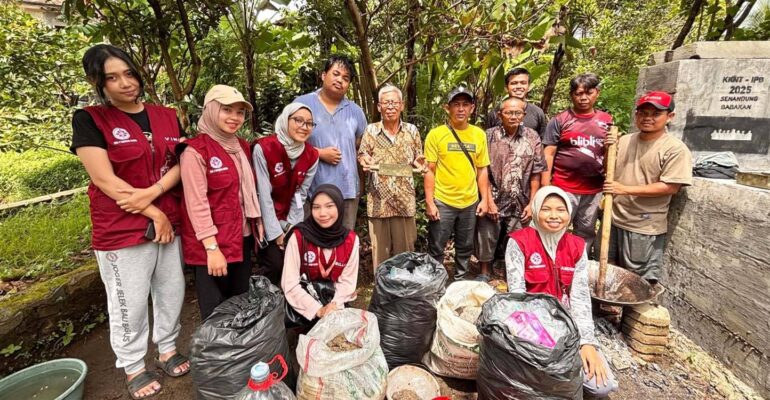
Plastic waste remains a classic problem in many villages, including Babakan Sadeng Village, Bogor, West Java. Plastic waste that is difficult to decompose often piles up, is disposed of carelessly, and ends up polluting the surrounding environment.
Based on this condition, students participating in the IPB University Innovation Real-Thematic Work Lecture (KKNT), who are members of the Babakan Sadeng Squad Group, presented a simple but impactful solution by making eco-paving blocks from plastic waste.
This activity was carried out together with the residents of Babakan Sadeng Village and was centered at the home of one of the residents who is active in the Environmentally Friendly Village (KRL) program. The atmosphere was relaxed and open to make residents feel comfortable to participate. The event was also attended by the Chief of Hamlet 2 of Babakan Sadeng Village, several RT heads, and enthusiastic residents who witnessed the plastic waste processing firsthand.
“During the KKN period, we observed that plastic waste here has not been managed optimally. Most of it was only collected, and even thrown into the river. However, if managed properly, plastic waste can be turned into useful and valuable products,” said Maria Ulfah Siregar, one of the student team representatives.
Based on this problem, she and her team introduced the concept of eco-paving blocks to the residents. The activity began with a brief socialization and an invitation to residents to collect plastic waste from their homes. The collected plastic waste was then used as raw material for making eco-paving blocks.
“We and the residents worked together to make eco-paving blocks. The process involved melting the plastic waste using used oil, then mixing it with sand before molding it into paving blocks,” explained Maria.
According to her, this method is quite simple, the tools are easy to find, and it does not require a lot of money.
The enthusiasm of the residents was evident throughout the activity. Many residents realized that plastic waste, which had been considered useless, could actually be processed into something useful.
“The knowledge shared by the IPB students was very helpful and useful for us. After seeing and trying the process ourselves, we realized that it was actually easy,” said the Chief of Hamlet 2, Babakan Sadeng Village.
Maria explained that compared to conventional paving blocks, these eco-paving blocks made from plastic are lighter in weight and have a relatively simpler production process. Through this activity, the Babakan Sadeng Squad IPB, together with the residents of Babakan Sadeng Village, demonstrated that waste management doesn’t have to be complicated.
With cooperation and shared determination, plastic waste can be transformed into an environmental solution. Eco-paving blocks not only help reduce plastic waste accumulation, but also open up opportunities for independence and environmentally-based economic potential in Babakan Sadeng Village. (*/Rz) (IAAS/HLF)

