Faculty of Medicine and Nutrition
IPB University has officially established the Faculty of Medicine and Nutrition (FKGiz) as a strategic step to address increasingly complex national health challenges. The faculty results from the integration of medical education with IPB University’s strengths in nutrition, food science, biosciences, and public health, while introducing a new model of integrated health education. The official renaming of the faculty was dated 15 January 2026.
Rector of IPB University Dr Alim Setiawan Slamet stated that the integration of the Faculty of Medicine and the Department of Community Nutrition is a strategic move to strengthen the development of knowledge, education, and research in the fields of integrated health and nutrition, aligned with national and global challenges.
He further emphasized that this step aligns with IPB University’s transformation as a bioscience and agromaritime based university, while reinforcing the one health paradigm and the life course approach.
“This integration is expected to encourage the development of integrated medical and nutritional sciences based on tropical biosciences, oriented toward delivering tangible solutions for society,” he explained.
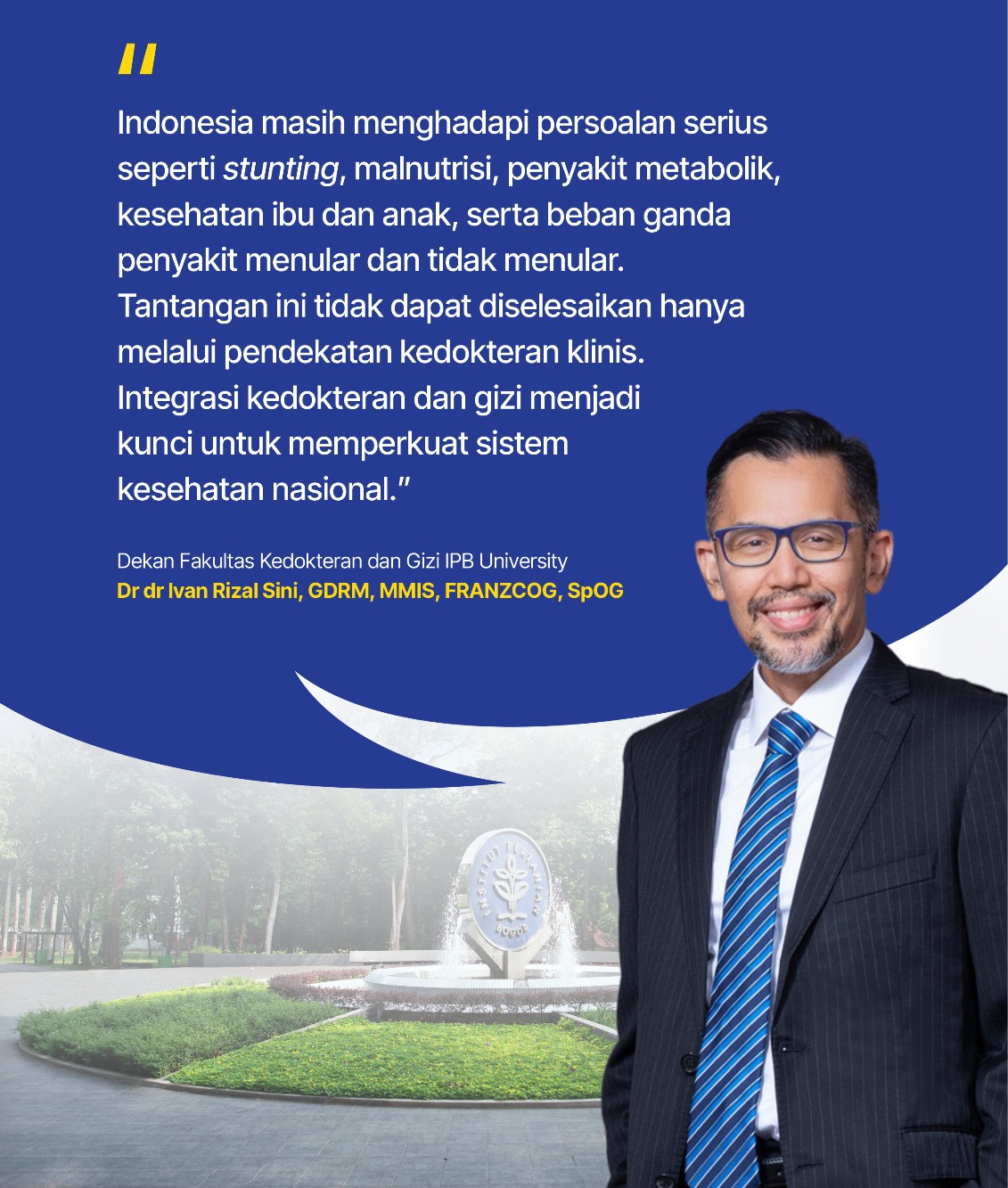
Dean of the Faculty of Medicine and Nutrition IPB University, Dr dr Ivan Rizal Sini, GDRM, MMIS, FRANZCOG, SpOG, explained that the establishment of FKGiz stems from the need for a more comprehensive and sustainable health approach.
“Indonesia continues to face serious issues such as stunting, malnutrition, metabolic diseases, maternal and child health problems, as well as the double burden of communicable and non communicable diseases. These challenges cannot be addressed solely through a clinical medical approach. The integration of medicine and nutrition is key to strengthening the national health system,” he stated.
According to him, IPB University possesses strong academic capital to develop such an approach. “IPB has historical excellence in agriculture, food, and nutrition. Therefore, through FKGiz, we position medical education within a comprehensive upstream-to-downstream health framework,” said Dr Ivan.
Through this approach, he continued, nutrition, food, environmental, and behavioral factors are not viewed as complementary elements, but as integral components in understanding diseases and prevention strategies.
“We want FKGiz graduates to be able to view health problems holistically, from prevention to clinical management,” he added.
Furthermore, FKGiz is designed to produce physicians with a strong community based herbal science approach, as well as a deep understanding of nutrition and food systems. This integration also strengthens the implementation of the Longitudinal Integrated Clerkship (LIC) model.
“This model allows students to gain continuous and contextual clinical experience, while also encouraging the strengthening of translational research and academic efficiency,” explained Dr Ivan.
Opening of the Nutritionist Study Program
As part of the faculty’s development, IPB University is also opening a Nutritionist Study Program this year. The program is established to address the gap between the demand for quality nutrition services and the availability of standardized nutritionists.
“Collaboration between doctors and nutritionists from the education stage is essential to build holistic, effective, and sustainable health services,” he stated.
To support the educational and clinical training process, IPB University also plans to develop a teaching hospital. This facility will serve as a platform for interprofessional learning as well as a center for research and promotive and preventive health services. “The IPB teaching hospital is designed as a real collaborative space between doctors and nutritionists,” he explained.
In terms of career prospects, FKGiz graduates will have broad opportunities in primary and referral healthcare services, public health programs, the food and nutrition industry, government institutions, as well as national and international research organizations.
“We are optimistic that FKGiz will produce health professionals who make tangible contributions to improving the health status of Indonesian society,” concluded Dr Ivan. (AS) (IAAS/CAA)
 ____________________________________________________________________________________
Rector’s Explanation on the Merger of the Faculty of Medicine and the Department of Community Nutrition into the Faculty of Medicine and Nutrition
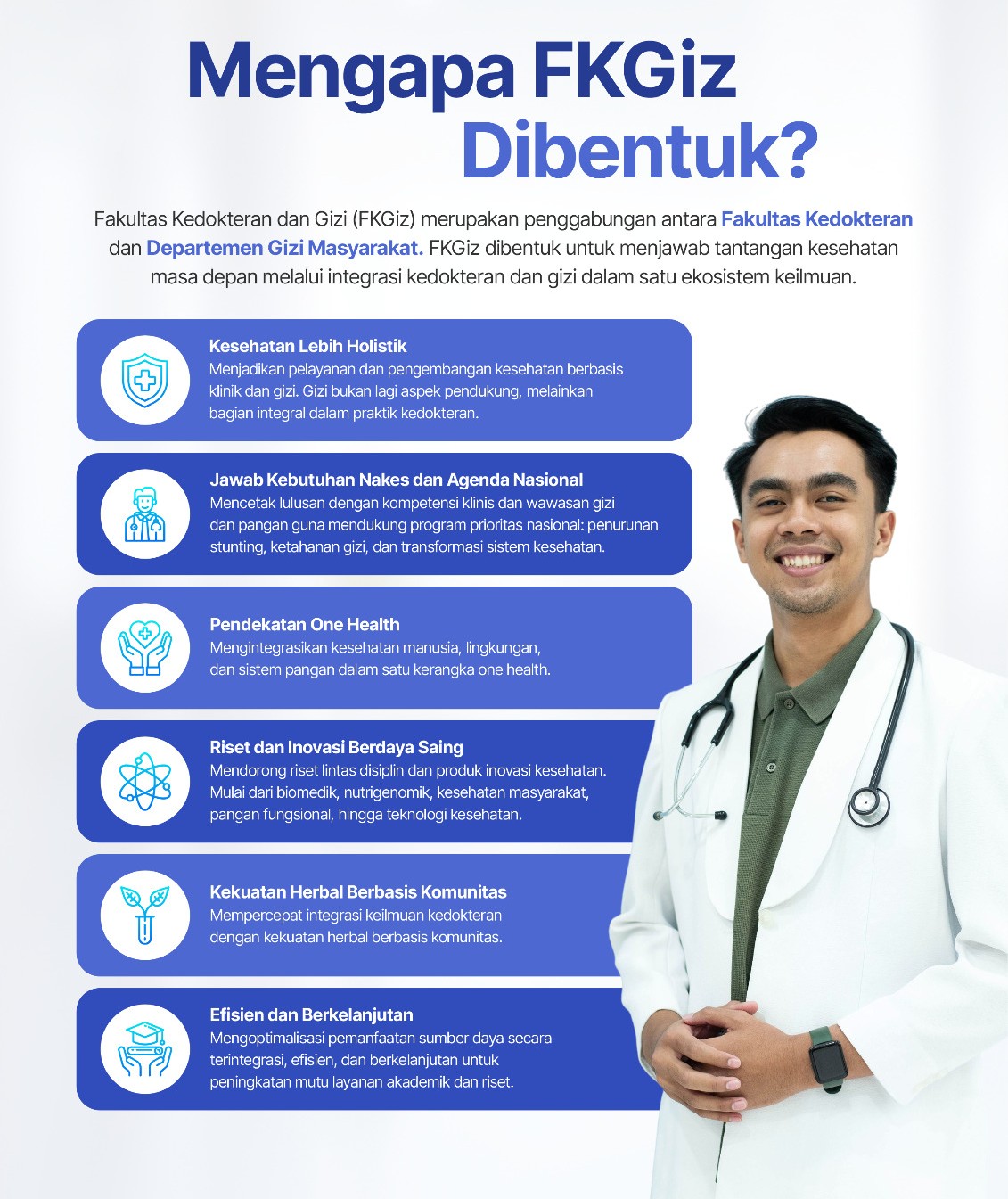
IPB University has officially established the Faculty of Medicine and Nutrition (FKGiz). The faculty was formed through the merger of the Faculty of Medicine and the Department of Nutrition Science.
Rector Dr Alim Setiawan Slamet explained that the establishment of FKGiz represents a strategic step by IPB University to strengthen the development of integrated scholarship, education, and research in the fields of health and nutrition.
“The establishment of FKGiz is relevant to both national and global challenges, and aligns with IPB University’s transformation as a bioscience and agromaritime based university,” he stated.
Further elaborating, the Rector outlined that substantively, the merger is based on six key considerations. First, strengthening a holistic approach in clinical and nutrition based healthcare services and development. The integration of medicine and nutrition enables a more comprehensive approach across promotive, preventive, curative, and rehabilitative spectrums.
“Nutrition is no longer positioned as a supporting aspect, but as an integral part of modern medical practice, particularly in addressing non-communicable diseases, maternal and child health, and strengthening public health,” he said.
Second, addressing the need for healthcare professionals and the national nutrition policy agenda.
FKGiz is designed to become a hub for producing healthy human resources with both clinical competence and a strong understanding of nutrition and food related issues.
According to him, this aligns with national priorities, including the acceleration of stunting reduction, strengthening nutritional resilience, transforming the health system, and supporting various government priority programs in health and food sectors.
Third, strengthening transdisciplinary scholarship development based on the one health approach. This merger reinforces the integration of human health, environmental health, and food and agricultural systems within a unified one health framework.
“FKGiz is expected to serve as a primary platform for developing transdisciplinary research and education linking infectious and zoonotic diseases, climate change, food security and safety, environmental quality, and sustainable nutrition. This is highly relevant to IPB University’s mandate and its academic development vision toward 2045,” the Rector stated.
Fourth, strengthening research collaboration, innovation, and institutional competitiveness.
Dr Alim emphasized that this merger opens broader opportunities for interdisciplinary research and innovation, ranging from biomedicine, nutrigenomics, and public health to functional foods and health technology.
This integration, he continued, will enhance IPB University’s capacity to produce reputable publications, patents, innovative products, and expand national and international partnerships in health and nutrition.
Fifth, accelerating the integration of medical science with community based herbal strengths. Graduates with strong community oriented characteristics will gain deeper competence in nutrition as part of a holistic integrated approach, encompassing education, prevention, early detection, curative, and palliative care.
“Broader exposure to nutritional sciences will be more easily achieved through strong interaction with health and medical sciences as a whole,” the Rector emphasized.
Sixth, optimizing resource utilization in a more efficient and sustainable manner. The management of faculty members, laboratories, educational facilities, and research infrastructure will be conducted in an integrated way. This will promote cost efficiency, strengthen cross-disciplinary faculty capacity, and improve the quality of academic and research services.
 ____________________________________________________________________________________
Transition Steps for the Faculty of Medicine and Nutrition at IPB University
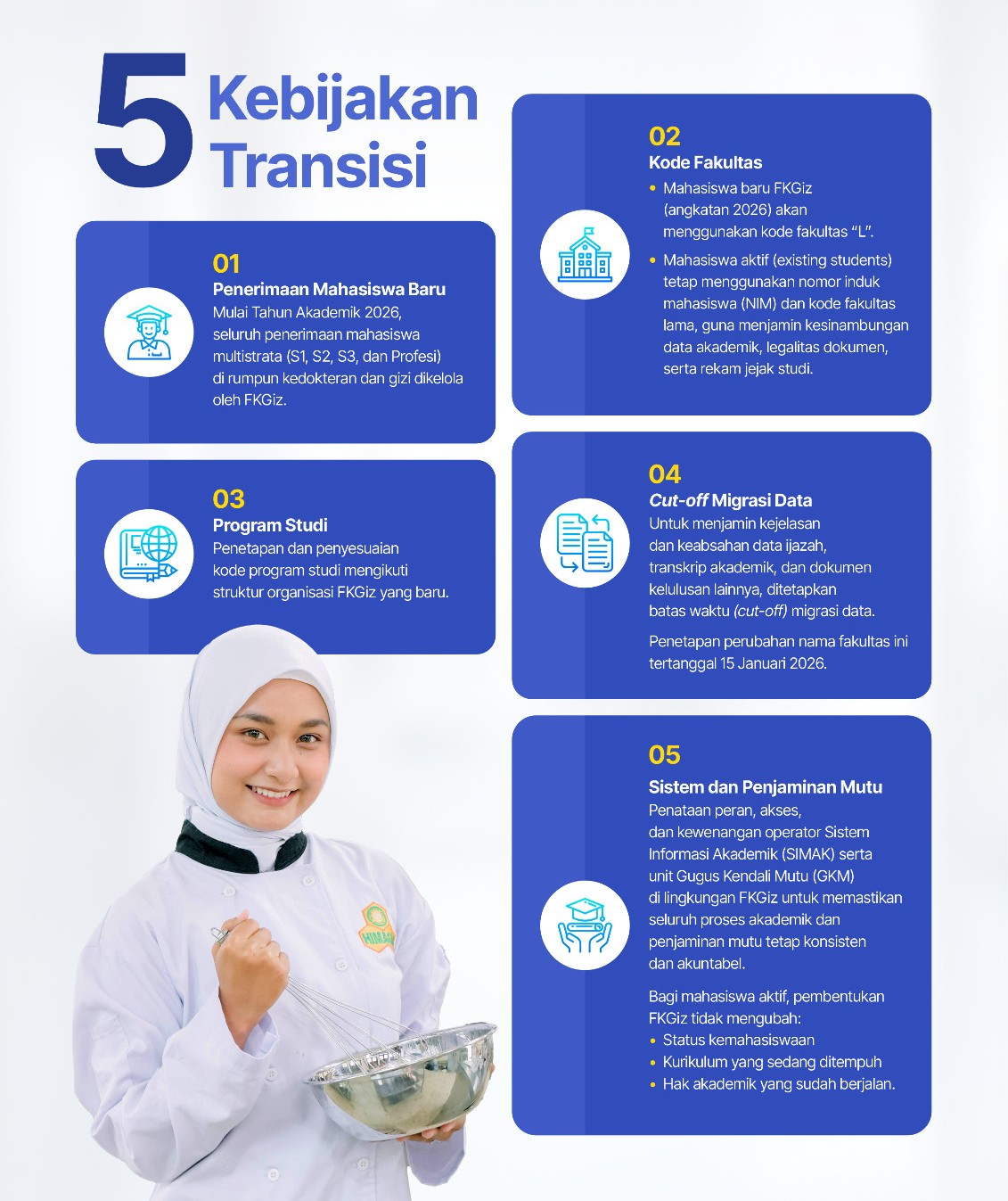
The Faculty of Medicine at IPB University has officially changed its name to the Faculty of Medicine and Nutrition (FKGiz). This new faculty is the result of the merger between the Faculty of Medicine and the Department of Community Nutrition, which was previously under the Faculty of Human Ecology.
To ensure the continuity of academic services, legal and administrative certainty, and smooth operational processes during the transition period, Rector Dr Alim Setiawan Slamet stated that IPB University has established several transition measures. The details are as follows:
- All new student admissions starting from the 2026 Academic Year for Undergraduate (Bachelor), Master’s, Doctoral, and Professional Programs in the fields of medicine and nutrition will be conducted and managed under FKGiz.
- New FKGiz students from the 2026 cohort onward will use the faculty code “L”.Meanwhile, existing students will continue using their current student identification numbers (NIM) and previous faculty codes to ensure continuity of academic records, document legality, and study history.
- The determination and adjustment of study program codes will follow the new organizational structure of FKGiz. All study program codes will be integrated into the academic system, institutional reporting, and national systems in accordance with applicable regulations.
- An official cut off date for the migration of student and graduate data has been established. This cut off serves as the basis for adjusting faculty data within the academic system, particularly to ensure the clarity and validity of data used in the issuance of diplomas, academic transcripts, and other graduation documents.
- Adjustments have been made to the roles, access, and authority of Academic Information System (SIMAK) operators and Quality Assurance Units (GKM) within FKGiz. This arrangement ensures that all academic processes, quality assurance, and institutional reporting remain consistent, accountable, and aligned with the new organizational structure during and after the transition period.
The merger does not change students’ enrollment status, ongoing curricula, or academic rights. All students will continue and complete their studies according to their respective curricula, with quality assurance and academic services maintained at an equivalent level and further strengthened through the establishment of FKGiz.
The Rector emphasized that the establishment of FKGiz is not merely a structural reorganization.“This is a strategic step to build an integrated, transdisciplinary, and globally competitive ecosystem for education, research, and innovation in health, nutrition, and food, while ensuring continuity in academic governance and services for all students,” he concluded.(*/Rz) (IAAS/CAA)