
Extreme Weather Intensifies, Experts Uncover the Roots of Flood Risk in Indonesia
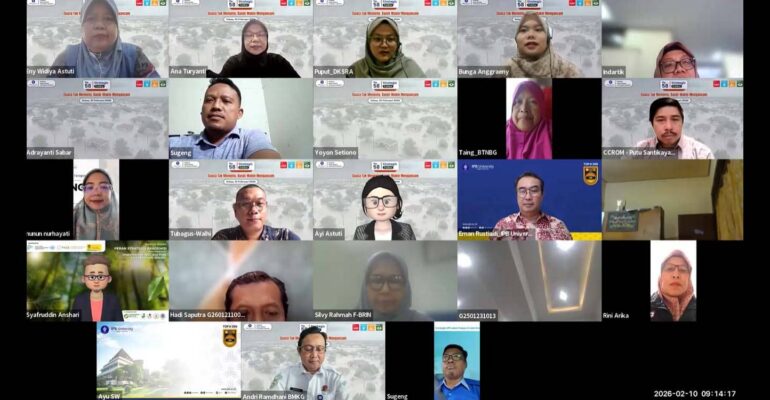
The risk of flooding in Indonesia is increasing as extreme weather events become more frequent. This issue was the main focus of the 58th IPB Strategic Talks entitled “Unpredictable Weather, Increasing Threat of Flooding,” which was held online on Tuesday (2/10).
IPB University Vice Rector for Research, Innovation, and Agromaritime Development, Prof Ernan Rustiadi, opened the discussion by emphasizing that extreme weather must be understood as a multidimensional phenomenon. “The impact of extreme weather must be a shared lesson,” he said.
Climate change, he said, has increased the complexity of disaster risks in Indonesia, particularly flooding in urban areas and regions with rapid land cover change. He cited flooding in North Sumatra as a concrete example of the recurring impacts of climate change.
According to him, disaster risk management cannot rely solely on technology and data, but also requires cross-disciplinary and cross-institutional collaboration. Therefore, he said, “Universities must become the link between science, policy, and society.”
In terms of data, the Meteorology, Climatology, and Geophysics Agency (BMKG) has recorded a significant increase in temperature. Dr Andri Ramdhani, Acting Deputy for Meteorology at BMKG, called that 2024 was the hottest period in the history of national observations.
“The rise in global temperatures correlates with an increase in extreme rainfall and flooding,” said Dr Andri.
Ocean and atmospheric warming contribute to the formation of extreme weather systems, including tropical cyclones such as Cyclone Senyar, which triggered heavy rains in the Sumatra region. According to him, the biggest challenge is not only the ability to predict the weather, but how that information is translated into concrete mitigation measures.
“We are developing an impact-based prediction system so that the information is more actionable for the community,” he explained.
Another scientific approach was presented by the Chief of the Center for Climate Opportunities and Risk Management for Southeast Asia and the Pacific (CCROM-SEAP), Dr I Putu Santikayasa. He explained that Indonesia has complex atmospheric dynamics because it is influenced by monsoons, the El Nino Southern Oscillation, the Indian Ocean Dipole, and the Julian Oscillation.
“Indonesia’s rainfall patterns are very complex,” he explained. According to him, the risk of flooding increases when climate change meets non adaptive spatial planning policies.
Land use change, rapid urbanization, and the reduction of water catchment areas increase the impact of extreme rainfall. Therefore, he believes that land use policies must be part of climate adaptation strategies. “Land use must support flood adaptation,” he added.
A sharper criticism was expressed by the Chairmam of the Indonesian Forum for the Environment (WALHI), Tubagus Saleh Ahmadi. “We are facing ecological bankruptcy,” he said bluntly.
Tubagus considers flooding to be a manifestation of the ecological crisis caused by uncontrolled exploitation of natural resources. Damage to forests and watersheds is said to accelerate the cycle of disasters.
He also highlighted the inequality of disaster impacts, which disproportionately affect vulnerable groups. He argued that overly technocratic policy approaches have failed to address the root of social problems. “Local participation is key to risk reduction,” he asserted.
The speakers agreed that the National Disaster Management Agency needs to play a central role as the coordinator of national flood mitigation. However, weak cross-sectoral coordination means that prevention efforts are often reactive. There needs to be a shift from emergency response to risk prevention. (MW) (IAAS/KQA)

