BKSAP DPR RI Visits IPB University to Discuss AI Development and Regulation
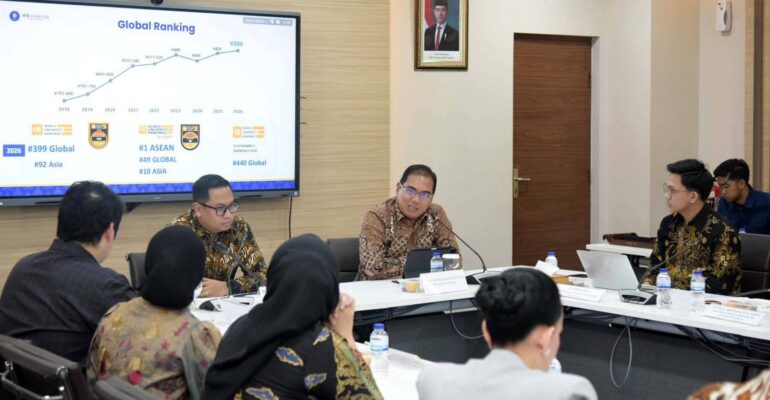
The Indonesian House of Representatives (DPR) Inter-Parliamentary Cooperation Agency (BKSAP), which is part of the Artificial Intelligence (AI) Working Committee (Panja), paid a working visit to IPB University. The purpose of this visit was to gather academic input on AI development and regulation in Indonesia. The delegation was received in Meeting Room 1 of the IPB Dramaga Campus, Bogor, on (2/4).
Vice Chair of BKSAP DPR RI and Chair of Panja AI, Bramantyo Suwondo, MIR, said the visit was part of BKSAP’s efforts to understand the development of AI and its impact on various strategic sectors. The AI Working Committee, he said, will strive to conduct special diplomacy to discuss global issues related to AI.
“We in the Working Committee will discuss the development of AI and how it can be regulated to help improve people’s lives quickly. AI has great potential to contribute to the job market. Several countries, such as Europe and Singapore, have already started implementing AI policies, but none of them have a comprehensive focus,” said Bramantyo.
He added that the AI Working Group is also paying attention to the development of educational curricula, including in the social and political fields. In addition, the AI Working Group has visited a number of institutions to discuss the role of AI in supporting agricultural resilience. According to him, AI has the potential to have a major impact on the agriculture, forestry, and fisheries sectors.
In response to this, IPB University Rector Dr Alim Setiawan said that IPB University’s research ecosystem is currently built on three main pillars of science. The first pillar is AI, which includes mathematics, data science, robotics, blockchain technology, and geospatial and space science.
The second pillar is omics science, which includes genomics, transcriptomics, proteomics, metabolomics, and various advanced biology disciplines. Meanwhile, the third pillar is sustainability science, which includes conservation, environmental science, the achievement of Sustainable Development Goals (SDGs), and natural resource management.
“At the intersection of these three pillars, social sciences play an important role in bridging technological innovation with society through the study of behavioral economics, ethics, governance, and public policy,” explained Dr Alim.
This integrated approach, he continued, is aimed at encouraging innovation, empowering communities, and accelerating sustainable transformation in the agro-maritime sector.
Meanwhile, the Chairman of the Artificial Intelligence Study Program at IPB University, Prof Yeni Herdiyeni, emphasized that the impact of AI will be optimal if it is supported by reliable data, effective field services, and integrated platforms. Therefore, according to her, AI policies need to overcome various obstacles in the ecosystem and promote efficiency.
Prof Yeni Herdiyeni also emphasized the role of the DPR as legislators to ensure that AI development in the food sector is carried out safely, accountably, and fairly. In addition, collaboration between the government and universities is needed in policy formulation, trial implementation, and the development of national AI talent. (dh) (IAAS/HLF)