Zeoponic Technology Overcomes Soil Quality Decline in Tegalrejo, Temanggung
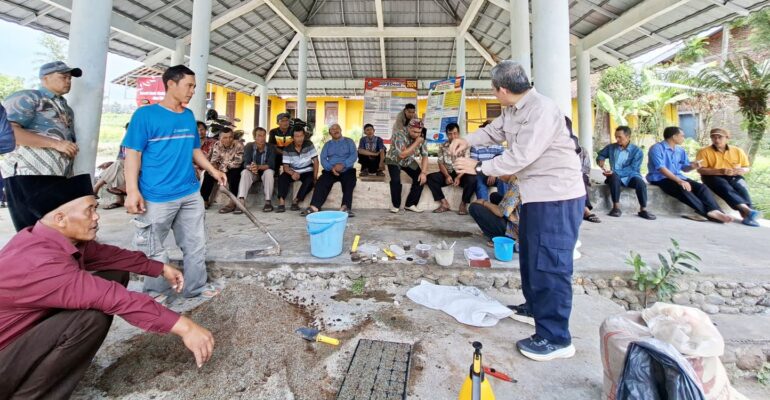
The IPB University Homecoming Lecturer Team (Dospulkam) introduced zeoponic technology to tobacco and horticultural farmers in Tegalrejo Village, Bulu District, Temanggung Regency (9/29).
Zeoponic is a natural zeolite-based planting medium. This innovation was developed by IPB University as an environmentally friendly technology to improve fertilizer use efficiency and maintain soil fertility in mountainous agricultural areas.
The Chair of Tegalrejo Village, Agus Nuryanto, expressed his appreciation for IPB University’s presence, which he considered to be a real solution to address soil quality decline and crop productivity.
“We are very grateful to IPB for coming directly to provide new knowledge to our farmers. In the future, we hope that Tegalrejo Village can develop a village owned enterprise (BUMDes) that is capable of producing its own zeoponic media,” said Agus.
The team was led by Prof Suwardi together with Dr Khursatul Munibah; Dr Dyah Tjahyandari Suryaningtyas; Ir Hermanu Widjaja, MScAgr; and Putri Oktariani, SP, MAgr. The participants consisted of several farmer groups (Gapoktan), such as Ayo Makaryo, Bumirejo-1, Bumirejo-2, and Guyup Rukun.
In the practice of making planting media, Prof Suwardi explained that zeolite has the ability to stabilize electrical conductivity (DHL) in the media. Zeolite is also able to prevent salt spikes and keep nutrients from being easily washed away.
“This allows plants to absorb nutrients in a balanced manner and grow healthier,” he explained.
The participants mixed ingredients such as zeolite, compost, cocopeat, and fertilizer. They also learned to measure pH and DHL to ensure that the growing medium was in optimal condition.
“Zeoponics can help farmers save on fertilizer and water, as well as stabilize seedling growth,” Prof Suwardi explained to participants during the field demonstration.
Zeoponics Innovation
Zeoponics technology was developed by IPB University in 2021 as an innovative growing medium for horticultural, forestry, and ornamental plant nurseries.
Compared to conventional media, zeoponic can store water and nutrients longer, while improving soil structure and supporting the activity of microorganisms that are important for plant growth.
This innovation was born from long-term research combining soil science, mineral engineering, and environmental technology, making it a practical solution for areas with marginal soil and limited water availability. Zeoponic media is suitable for tobacco and horticultural crops such as chili peppers, eggplants, and cabbages, which are commonly found.
In addition to practical demonstrations and discussions, the team provided initial guidance to help farmers prepare local materials that can be adapted as components of zeoponic media, enabling the community to independently apply this technology.
“We hope that activities like this can continue to be carried out, so that farmers in the region become more tech-savvy and can develop businesses based on local resources,” said Dr Khursatul Munibah. (*/Rz) (IAAS/KQA)