
Without Thick Smoke, IPB University Students’ Incinerator Helps Villages Manage Waste
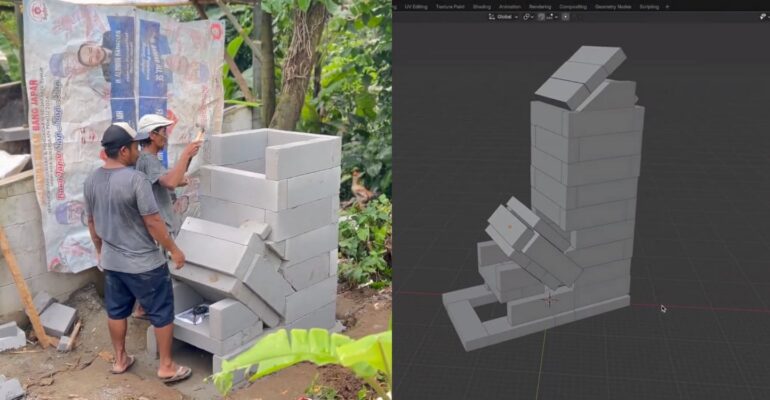
The low-smoke incinerator created by students participating in IPB University’s Innovation Real-Thematic Work Lecture (KKNT) program is a solution for village waste management, which has traditionally been carried out through open burning. This simple tool reduces thick smoke, reduces waste accumulation, and is more environmentally friendly and easy for the community to use.
The issue of village waste is not new. Limited access to final disposal sites (TPA) has led some residents to burn waste in their yards. While this method is considered practical, it has a negative impact on air quality and public health.
Students from the IPB University KKNT program in Cicadas Village, Bogor Regency, then designed a low-smoke incinerator as an appropriate technology. Team representative Indra Bagus Ramdhani said this innovation stemmed from real problems in the field.
“We saw waste problems in Cicadas Village, such as piles of illegal waste, and some people even dumping waste into the river,” said Indra, a student in the Department of Chemistry at IPB University.
Akma Naufal Rabbani, another student team member, added that the waste problem in the village was not only related to community behavior but also to limited facilities.
“The biggest problem is the lack of waste infrastructure. Almost all neighborhood associations (RT) or community associations (RW) do not have waste infrastructure or management systems,” he said.
In addition, Akma highlighted the low level of public awareness regarding the payment of garbage fees. This situation often causes communal garbage collection to be halted. “Sometimes it can be stalled for up to three months,” he said.
According to Akma, the existence of low-smoke incinerators can minimize the need for garbage collection. During a trial period of nearly one month, there was no significant increase in the volume of garbage.
“Residents’ expenses for waste transportation, which previously amounted to around one million rupiah per trip, can be reduced to the operational costs of sanitation workers,” he explained.
Technically, this incinerator is made of easily obtainable hollow bricks. Its design features an elongated combustion chamber with air flow control so that the fire burns more stably and combustion smoke is significantly reduced. This allows the community to burn waste without polluting the air quality.
The presence of the low-smoke incinerator was welcomed by residents and village officials. Akma said the inauguration of the equipment received a positive response. “Representatives of the neighborhood association and the village head were present and expressed their gratitude for our team’s presence in building this incinerator,” he said.
He hopes that this innovation can be replicated in other areas. “Our initial goal was indeed to replicate it in 32 other neighborhoods. We made the design as simple as possible so that it can be imitated and applied,” he said.
Through this innovation, students from the IPB University KKNT program hope that village waste management can be carried out in a more sustainable manner, while also fostering collective awareness among the community about the importance of a clean and healthy environment. (Fj) (IAAS/HAN)

