When Coffee Husk Waste in Ciwidey is No Longer Wasted
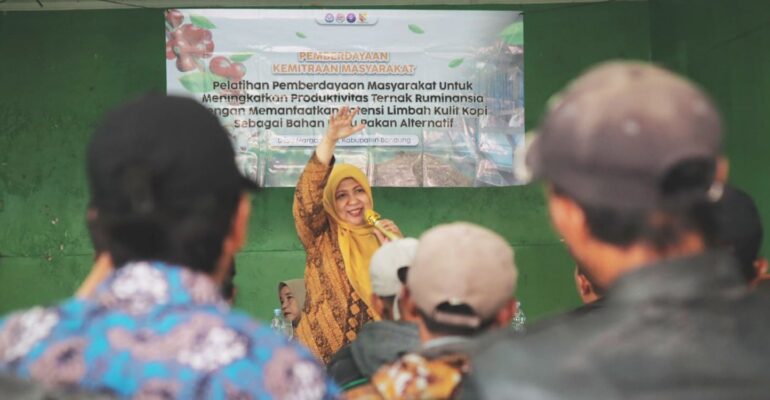
The IPB University Homecoming Lectures (Dospulkam) conducted community service by offering solutions for the utilization of coffee husk waste in Ciwidey, Bandung Regency, West Java.
For years, coffee husk waste in Margamulya Village, Pasir Jambu District, and Ciwidey has been an unresolved environmental problem.
Every harvest season, dozens of tons of coffee beans are processed to extract the seeds. Meanwhile, coffee husk waste or coffee pulp is simply piled up on the side of the road, in gardens, and even in small rivers around the village.
However, this situation has begun to change thanks to the initiative of the Margamulya Village Owned Enterprise (BUMDes) together with the Dospulkam team from IPB University. Together, they developed an innovative program to process coffee pulp waste into environmentally friendly goat feed.
The chairperson of the Dospulkam team, Prof Yuli Retnani, said that this innovation is a breath of fresh air for the residents of Margamulya, the majority of whom are coffee farmers and raise a small number of livestock as a form of investment. She is not alone in running this program, as she is joined by Dr Heri Ahmad Sukria, Dr Indah Wijayanti, and Dr Nisa Nurmilati Barkah.
So far, the coffee processing in Margamulya has produced around 8 tons of coffee cherries per day. Of that amount, about 60 percent is coffee husks, resulting in at least 5 tons of coffee husk waste every day.
“In one month, the total production of coffee husks collected reaches 150 tons. These coffee husks, which are waste products from processing, are thrown away for free,” said Prof Yuli.
Without proper management, this amount has the potential to pollute the environment. The pungent sour smell of fermented coffee husks is often complained about by local residents and passing motorists. This condition is exacerbated during the rainy season because the waste is easily carried away by water and pollutes residents’ agricultural land and waterways.
Through the Dospulkam program, the coffee husk waste is now processed into high quality mash (fine flour) for goats. The processing is quite simple: the coffee husks are dried naturally in the sun until their moisture content decreases, then ground using a grinder into a mash.
The final product is used as a goat feed mixture, replacing some of the need for more expensive feed supplements such as concentrates. Farmers simply alternate between feeding the goats this coffee husk feed and forage.
“From a nutritional standpoint, dried coffee husks have a fairly good crude fiber and energy content for ruminant feed, especially goats,” explained Prof Yuli.
Field trials also showed that goats were willing to consume this mash feed, did not show a decrease in appetite, and even maintained normal weight gain. The fiber content in coffee husks aids rumen fermentation, although dosage must be regulated to avoid exceeding the crude fiber threshold in the ration.
This program not only impacts livestock farming but also brings environmental benefits. The volume of coffee husk waste in the village has begun to decrease, and the pungent odor is no longer as strong as before. Additionally, the risk of water and soil contamination from coffee waste can be reduced.
“This is proof that circular economy-based waste management can create added value while solving environmental problems,” she said.
BUMDes Margamulya is currently preparing to produce coffee husk mash feed on a larger scale to meet the needs of farmers outside the village. Prof Yuli hopes that the support from IPB University through Dospulkam can encourage the development of more efficient and hygienic processing technology.
“In the future, Ciwidey is targeted to become a model village for sustainable coffee waste processing in Indonesia, which can be replicated by other coffee-producing regions such as Garut, Temanggung, or Aceh Gayo,” she said.
With this innovation, waste that was once considered a problem has now become a blessing for farmers and the village environment. This business model also opens up new economic opportunities that can increase village income through the production and sale of coffee husk based feed. (*/Rz) (IAAS/LAN)