The Story of Prof Sofyan Sjaf Behind the Silver Winner Award at the 2025 Diktisaintek Awards
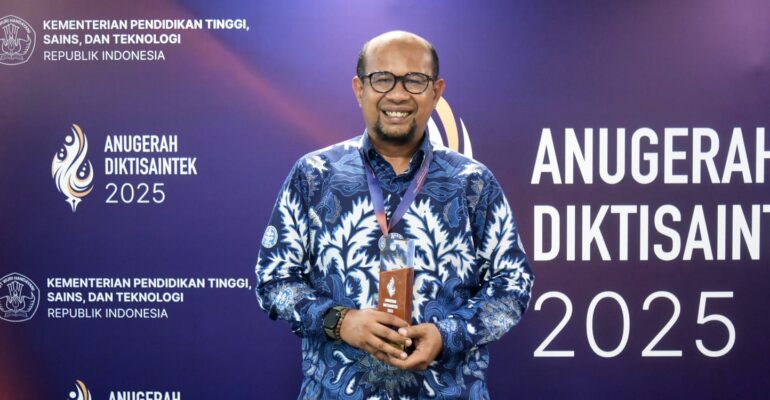
The initiator of Precision Village Data (DDP) and Dean of the Faculty of Human Ecology (Fema) at IPB University, Prof Sofyan Sjaf, won the Silver Winner of the 2025 Diktisaintek Research and Development Award in the category of Best Senior Scientist in the Field of Social Humanities Innovation.
This award was given as a form of government recognition for Prof Sofyan’s contribution in developing data-based social innovation that has a direct impact on village development in Indonesia. For Prof Sofyan, this award is proof that social humanities innovation has a measurable and tangible impact.
“Honestly, I did not expect to receive this award. For me, a scientist must continue to work. I have been working on this since 2006, starting from my concerns and worries about the condition of our vast country, which still has fundamental problems in data collection,” said Prof Sofyan to the IPB Today editorial team (12/24).
Prof Sofyan explained that DDP is a data collection methodology innovation that combines digital technology, community participation, and social-spatial data integration, especially in rural areas. The DDP innovation was developed in response to the weaknesses of the old (top down) data collection system, which was often inaccurate, irrelevant, and did not empower villages.
“The development of Precision Village Data is a long process that began with direct activities in villages in 2006. In 2017, research focused on finding an innovation formula that could be accepted and implemented by village communities. This innovation began to be implemented in 2020,” explained Prof Sofyan.
Through a bottom up approach, DDP opens up space for village communities to participate in building their own data, utilizing easy-to-use digital technology. The university acts as a facilitator and supervisor, until eventually the villages are able to manage their data independently.
“Our goal is to build big data from the bottom up, and ensure that access to this data is also enjoyed by villages, not just supra-village levels such as sub districts or districts,” he said.
By 2025, the implementation of Precision Village Data has reached 16 provinces, 34 districts/cities, and 543 villages. This number is planned to increase to around 1.239 villages in the following year. This program has involved more than 10.000 villagers and more than 900 academic networks from various universities.
“Through DDP, villages can precisely identify who is poor, who lacks electricity, toilets, access to education, and even food consumption patterns. All of this forms the basis for village development planning,” explained Prof Sofyan.
He added that precision data-based planning enables villages to address macro issues such as poverty, unemployment, inequality, and gender inequality in a more targeted and accountable manner. He hopes that DDP will be supported by various parties and implemented in all villages in Indonesia. MHT)( (IAAS/NVA)