
Support the JÀKA-TARUB Community in Developing Brebes Unique Sakub Sheep
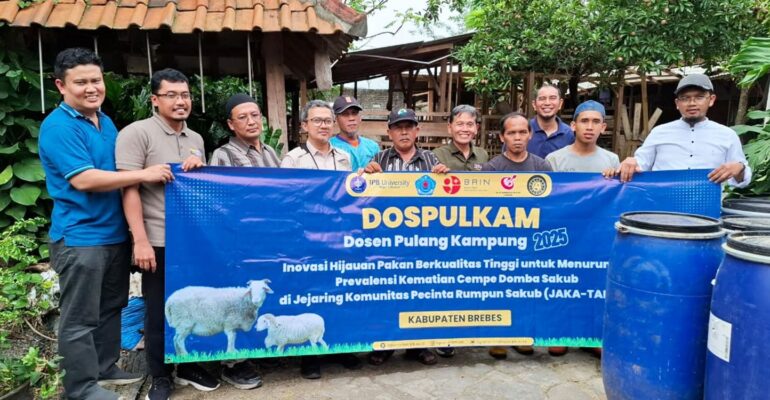
Efforts to preserve and increase the economic value of Sakub sheep have been given a new lease of life. Through the Homecoming Lectures (Dospulkam) program, the IPB University team has introduced innovative high quality forage for the development of sheep unique to Brebes Regency, Central Java. The focus is on reducing lamb mortality rates so that productivity can increase.
The activity is targeted at members of the Sakub Sheep Lovers Community Network (JAKA-TARUB), a livestock community organization led by Dr Iwan Prihantoro, an IPB University lecturer and local figure who is also a Sakub sheep conservationist. More than 50 participants were involved. They included local farmers, extension workers, students, and livestock business operators.
According to one of the lecturers, Dr Muhammad Baihaqi, Sakub sheep have tremendous potential to be developed as high-quality meat livestock, if supported by a structured genetic selection program.
“To meet the needs of the upper-middle-class market and exports, we must begin preparing sheep breeds that are not only environmentally resilient but also superior in carcass quality. Sakub sheep possess these fundamental characteristics,” he stated during his appearance as a guest speaker on the Dospulkam program (7/5).
On the same occasion, Edit Lesa Aditia, SPt, MSc, conveyed the vital role of morphometric identification. For him, morphometric identification is not just a matter of numbers, but the basis for germplasm preservation and legal recognition of a livestock breed.
“Through morphometric measurements such as shoulder height, body length, and chest circumference, Sakub sheep can be identified more specifically than other local sheep breeds. This is important for genetic conservation and herd standardization in national development programs,” he explained.
In closing, Dr Dilla Mareistia Fassah touched on the issue of lamb mortality, which has long been a challenge for farmers. The key, she said, is adequate nutrition. “Many cases of lamb mortality and stunting in smallholder farms are caused by a lack of nutrition in both the mother before giving birth and the young lambs,” she said.
She elaborated by giving an example of the flushing method, which is the provision of high-nutrient feed to mothers before and after mating. This method has been proven to increase pregnancy rates and the quality of offspring. Meanwhile, the creep feeding technique, or the provision of special additional feed for young goats from an early age, can also reduce the risk of mortality and growth disorders.
The Dospulkam team also collected data and recorded Sakub sheep raised by community members, which was carried out directly by Dr Sigid Prabowo. This was done to support the development of a genetic and production database as the basis for the Sakub breed selection and conservation program.
This entire series of activities is part of a systematic effort to support the development and conservation of Sakub sheep as a superior local breed unique to Brebes, while strengthening the synergy between universities and the farming community in improving the productivity and sustainability of smallholder farming.
Support for the JAKA-TARUB community is one of the concrete steps taken by IPB University to realize its vision of service that directly impacts the welfare of farmers and the conservation of Indonesia’s livestock genetic resources. (*/Rz) (IAAS/NRA)

