
Responding to the Sinkhole Incident in West Sumatra, IPB University Researcher: Alarm Bells for Failed Land and Water Management
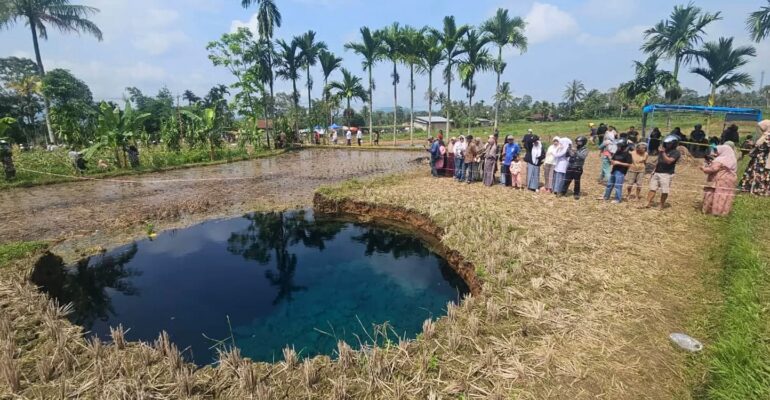
The phenomenon of sinkholes or collapsed ground that occurred in West Sumatra can no longer be viewed as a purely natural occurrence. The sudden appearance of collapsed holes in residential and agricultural areas is a clear indicator of a crisis in land and groundwater management that has been overlooked.
Professor of Soil Science at IPB University, Prof Widiatmaka, explained that scientifically, sinkholes are formed due to the loss of soil structure stability through leaching and subsurface erosion (piping). This process mainly occurs in fine to medium textured soils above soluble rocks or porous layers.
“High rainfall does play a role as a trigger, but the main cause is the weakening of the soil structure due to the loss of fine particles from the lower layers. The cavities form slowly, but the collapse can be very sudden,” he said.
In many cases, he continued, this condition is exacerbated by human activities that drastically alter the groundwater system. Excessive groundwater extraction, drainage construction without hydrogeological studies, and land use without calculating soil bearing capacity accelerate soil structure failure.
According to him, land use change is a key factor that is often overlooked. The conversion of forests and vegetated land into built-up areas or intensive agriculture eliminates the ecological function of soil as a water and structural buffer.
“The loss of vegetation cover and soil organic matter reduces soil aggregation. As a result, the soil loses cohesion and becomes highly susceptible to internal erosion through piping,” he explained.
Under these conditions, rainwater is no longer distributed evenly, but rather concentrated in certain pathways below the surface. This concentrated water flow accelerates the formation of cavities and weakens the soil cover layer.
Prof Widiatmaka considers excessive groundwater exploitation to be the most dangerous factor because it acts like a “time bomb” below the surface. Rapid decline in the water table removes the natural pressure supporting the underground cavities. Meanwhile, repeated wet dry fluctuations weaken soil cohesion.
“Without strict control, groundwater extraction not only threatens water availability but also compromises land stability and human safety,” he emphasized.
Most Vulnerable Areas
In Indonesia, sinkholes are most likely to occur in fine to medium-textured soils in karst (limestone) areas and old volcanic materials that have become severely weathered. These conditions are commonly found in the karst areas of Gunung Sewu (DIY–Central Java), Maros–Pangkep (South Sulawesi), North and South Kendeng (Central Java–East Java), Citatah–Padalarang (West Java), and Sangkulirang–Mangkalihat (East Kalimantan).
In addition, areas with old volcanic material that has undergone intensive weathering, such as the Bandung Basin and its surroundings, the slopes of old volcanoes in central and western Java, and several areas in western Sumatra, also have the potential for sinkhole formation.
“These soils generally have a weak structure, high porosity, and are poor in organic matter, making them prone to subsidence when there are changes in groundwater flow,” he explained.
Sinkholes have a direct impact on land sustainability, damaging infrastructure, disrupting drainage, and reducing agricultural productivity. From an environmental perspective, land subsidence alters water flow and increases the risk of groundwater pollution.
As a mitigation measure, Prof Widiatmaka emphasized that sinkhole management should not be reactive. Identification and mapping of land vulnerability must be carried out through integrated scientific studies, reinforced by groundwater monitoring and shallow geophysical surveys.
“Sinkholes are a stark warning that our water system is unhealthy. Without synergy between science and policy, land subsidence is only a matter of time,” he concluded. (AS) (IAAS/EPK)

