
IPB University’s Ecological Urban Farming Proven to Lower City Temperatures and Strengthen Urban Food Security
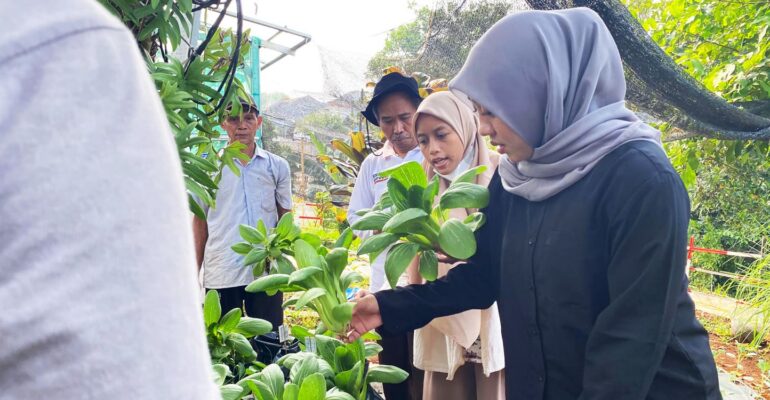
The Faculty of Agriculture at IPB University, in collaboration with Rikolto Indonesia and the Indonesian Association Berseru, has successfully developed a multifunctional urban farming model for urban areas.
The research was conducted at six locations in Depok City, West Java, during the 2023–2025 period. The two year study results show that ecological urban farming has three main functions.
First, providing healthy food for urban communities, particularly fresh vegetables that are pesticide-free and affordable. Second, improving environmental quality, marked by a decrease in the diurnal temperature range (DTR), which makes the surrounding area more comfortable to live in while also contributing to household waste management. Third, economic function, in the form of group-scale economic circulation through the production and sale of local products.
These findings were presented at the Dissemination of Ecological Urban Farming Based on Heat Islands held at the Margo Hotel, Depok. The event was attended by multiple stakeholders, including the Director of Rikolto Indonesia, the Indonesian Association of Berseru, the Dean of the Faculty of Agriculture at IPB, the Chair of the Agriculture and Food Security Office of Depok, the Chair of the Environment Office of Depok City, the Directorate of Agriculture and Food at Bappenas, the Directorate General of Horticulture, and urban farmers in the Depok area.
“The results of two years of research show that the application of ecological urban farming has been proven to improve soil health, as indicated by an upward trend in the productivity of several major vegetables and a decrease in the incidence of pests and diseases,” said Prof Suryo Wiyono, Dean of the Faculty of Agriculture at IPB, who is also the leader of the research team.
Various IPB University technologies were applied in this model. These include landscape design for more functional and efficient space utilization, the use of biological agents to control pests and diseases, and achieving zero pesticides.
In addition, the selection of plant types and varieties, soil amelioration, and the use of automatic weather stations (AWS) for crop planning were carried out.
On the same occasion, Dr Idung Risdiyanto, an agrometeorology expert from the Department of Geophysics and Meteorology at IPB University, stated that ecological urban farming has a significant impact on reducing the DTR.
“This proves that the existence of community gardens directly contributes to reducing the air temperature in the surrounding area and improving the thermal quality of the environment, which has a positive impact on reducing health risks for urban residents,” he said.
For future sustainability, the research team recommends improving land certainty, using several types of high-value crops, integrating with agricultural extension systems, using appropriate technology, and integrating with the Free Nutritious Meals (MBG) program to broaden its benefits. (*/Rz) (IAAS/AVM)

