
IPB University Students Initiate Ferternak, Addressing Livestock Farmers’ Challenges in Manggosteen Producing Village in Bogor
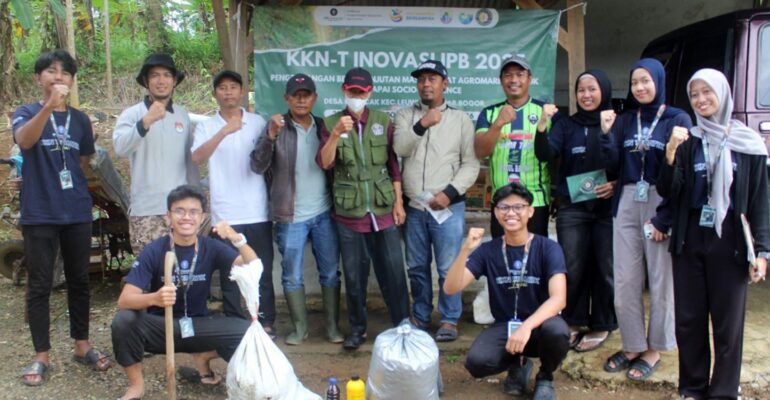
Innovation Real Thematic Real Work Lecture (KKNT) Team from IPB University carried out a flagship program entitled Ferternak (Feed and Livestock Waste Fermentation) in Karacak Village, Leuwiliang District, Bogor Regency. Karacak Village is well known as one of Bogor’s main mangosteen producing areas.
The program was designed as an innovative effort to manage livestock feed and waste comprehensively from upstream to downstream. Ferternak focuses on the application of simple yet practical technologies, namely the production of silage as fermented animal feed and the processing of livestock manure into organic fertilizer (KoHe).
“This program was designed to address issues commonly faced by farmers and livestock breeders, such as the limited availability of quality feed during certain seasons and suboptimal livestock waste management,” said Fauzan Bara Putra, team representative and initiator of the Ferternak program.
The activities were carried out through a series of socialization sessions from December 25, 2025, to January 12, 2026, across several livestock farms in Karacak Village, and concluded with a demonstration session on January 13, 2026.
During the socialization phase, the team visited local livestock farms to provide insights into the benefits of feed fermentation and livestock waste processing. The materials covered basic fermentation principles, required materials and equipment, silage production stages, and the process of converting animal manure into environmentally friendly and valuable organic fertilizer.
The peak of the Ferternak program was marked by a hands on demonstration of silage and KoHe fertilizer production, attended by farmers, livestock breeders, and village officials. Participants were not only given explanations but were also directly involved in material chopping, mixing, and fermentation processes. Community enthusiasm was evident through active participation and lively discussions throughout the activity.
The Chief of Karacak Village, Hj Onas Hestiani, SIP, expressed her appreciation for the program and hoped it would bring sustainable benefits to the village community.
“I hope that through the Ferternak program, farmers’ and livestock breeders’ knowledge and understanding in Karacak Village will increase, particularly in managing animal feed and livestock waste. Simple innovations like this are highly beneficial in improving productivity while also preserving the environment,” she stated.
Ferternak was initiated by Fauzan Bara Putra and Muhammad Ramadhan Yudha Prawira, students of the Faculty of Animal Science, IPB University. The program was then collaboratively implemented with the entire Innovation Real Thematic Real Work Lecture (KKNT) team, consisting of Alima Zia Mufida, Farihah Malvalena, Kinanthi Amurwani Estu Respati, King Budi Satria Halim, Muhammad Raifan, and Cyril Ghina Nandy Aula.
“Through the Ferternak program, we aim to encourage farmers’ and livestock breeders’ independence in providing quality animal feed and managing waste sustainably. We hope this program can continue to be applied and further developed by the Karacak Village community as a concrete step toward a more efficient, economical, and environmentally friendly livestock system,” Fauzan concluded. (* /Rz) (IAAS/CAA)

