IPB University Faculty of Medicine Ready to Enter the Era of AI and Robotics Based Medicine
IPB University continues to expand its contribution to national development by strengthening its Faculty of Medicine (FK). Entering its third year since its establishment, the Faculty of Medicine (FK) IPB continues to grow and achieve significant accomplishments in the fields of education, research, and health technology transformation.
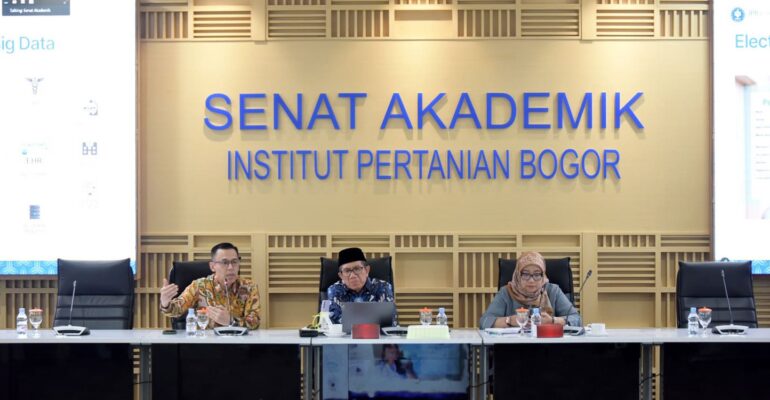
This was conveyed by the Dean of the Faculty of Medicine (FK) at IPB University, Dr dr Ivan Rizal Sini, GDRM, MMIS, FRANZCOG, SpOG, in a sharing session overview entitled “Faculty of Medicine (FK) for Future Medicine” at the Academic Senate (SA) Plenary Session in the SA Meeting Room, IPB Dramaga Campus, Bogor (1/20).
Dr Ivan said that IPB University is not only known for its strength in agromaritime studies, but also has great potential in the development of the medical sciences.
“The Faculty of Medicine (FK) is currently in its third year and we have an ideal number of faculty members and students as an initial investment in the development of the faculty,” he said.
He added that the IPB Faculty of Medicine (FK) completed the accreditation process at the end of 2025 and continues to maintain consistent development in accordance with the Strategic Plan (Renstra).
“The IPB Faculty of Medicine (FK) has also implemented community based health education through a continuous transformative curriculum starting from the undergraduate level,” explained Dr Ivan.
Clinical deepening, early exposure to medical technology, and the development of genomics, herbal medicine, and the one health approach are important parts of this development direction. All of these concepts, he said, are translated into investments in infrastructure, including plans for teaching hospitals and community clinics.
In the context of technological transformation, Dr Ivan highlighted the major changes after the COVID-19 pandemic that have driven the adoption of digital technology, telemedicine, electronic medical records (EMR), artificial intelligence (AI), and robotics.
He emphasized that data is the main asset in the development of modern health services. “With a strong database and proper governance, we can develop big data analytics capabilities that are integrated with the overall capacity of IPB University,” he explained.
One of the main highlights is the development of robotic surgery as part of curative services. According to Dr Ivan, this technology enables more precise medical procedures, minimal bleeding, and faster recovery.
“Robotic surgery does not involve robots replacing doctors, but rather doctors controlling robots with a high degree of accuracy,” he said. He gave an example of how operations that previously required a long recovery time can now be performed with a short hospital stay.
He also emphasized the challenges of equitable health care in Indonesia, particularly the limited access to specialists in rural areas. In this regard, the development of telesurgery and adaptive health policies present opportunities for national service transformation.
Dr Ivan believes that IPB University has a great opportunity to contribute through cross faculty collaboration, ranging from AI research, medical device development, health worker training, to health policy and economic studies.
“Medical technology is a long-term investment. IPB University is ready to be part of the ecosystem that builds access to quality health care services,” he said. (dr) (IAAS/FHD)