
IPB University Disseminates Wood Species and Origin Identification Program
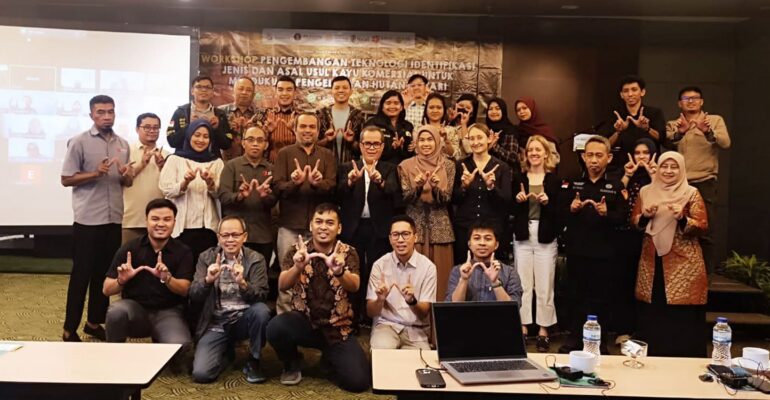
IPB University, through the Workshop on the Development of Commercial Wood Species and Origin Identification Technology, encourages the strengthening of sustainable forest management based on science and technology.
The event, titled “Dissemination of the Indonesian-Based Wood Identification Program,” was held at the IPB International Convention Center (IICC), Bogor (1/22), and was attended by stakeholders from various sectors, both in person and online.
Vice Rector for Global Connectivity, Collaboration and Alumni Relations, Prof Iskandar Z Siregar, said that this program has developed from its initial stages to have a continuously strengthened research capacity.
“I happen to be the principal investigator of this activity since the beginning. We reported on the achievements that have been made and how the results were developed together with stakeholders,” he said.
He explained that wood identification includes determining the type and origin, which is crucial in international trade to ensure product integrity.
This is in line with the implementation of global regulations such as the Lacey Act in the United States and similar policies in Europe and Australia. “Wood identification technology is very important for global trade and the national economy,” said Prof Iskandar.
This programme integrates various scientific approaches, including wood anatomy, genetics, stable isotopes, and chemical analysis using Direct Analysis in Real Time–Orbitrap (DART-OV) technology.
In addition to building a reference database, Prof Iskandar continued, the programme also emphasises sustainable capacity building. Three types of model wood were selected, namely red meranti (Shorea leprosula), bangkirai (Shorea laevis), and ramin, which represent the main ecosystems and distribution of Indonesian forests.
Samples were collected in various areas, ranging from national parks to areas managed by the Forest Utilisation Business Permit (PBPH) and protected forests, with licensing support from the Ministry of Forestry.
“The collected data is used to develop distribution models, heat maps, and analyses of the uniqueness of the chemical, DNA, and isotope spectra of each location,” said Prof Iskandar.
Tina Schneider, Director of Forest Governance and Policy World Resources Institute (WRI) Washington DC, stated that the use of forensic tools for timber identification is crucial in combating illegal timber trade.
According to her, “The question of whether the wood comes from the right species and location is key to creating a legal and sustainable supply chain.”
She added that global collaboration through networks such as World Forest ID enables the strengthening of cross-border chemical, DNA and isotope databases, including in the Asia-Pacific region, which still needs data enrichment.
Researchers from various stakeholders participated in this workshop. In addition, this activity also involved the Indonesian-Based Wood Identification Program research consortium in the development of wood identification technology in Indonesia. (dr) (IAAS/ZHR)

