ICOFISH-MT: A Smart Solution for Resolving Fisheries Conflicts in Labuhan Haji Village
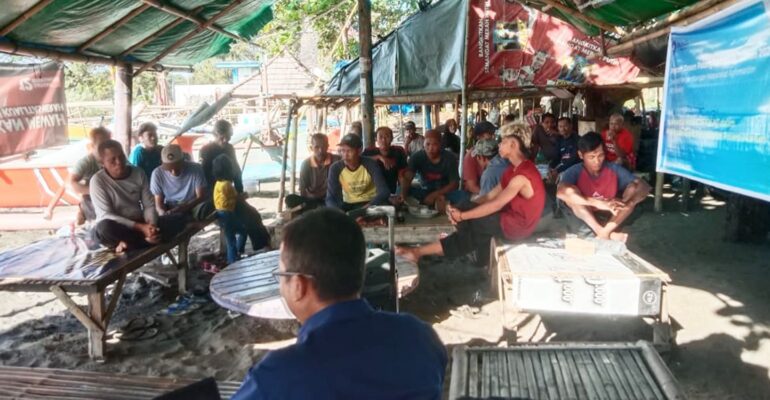
The Homecoming Lectures (Dospulkam) Team from IPB University provided training on the ICOFISH-MT model to fishermen, tourism actors, and the community in Labuhan Haji Village, East Lombok Regency, West Nusa Tenggara (NTB). The activity involved partners from the Technical Implementation Unit (UPT) of the Port and the Masbagik Youth Group.
ICOFISH-MT or integration of coastal fisheries management and marine tourism is an approach model that helps resolve conflicts by building synergy/integration in activities that tend to be at odds.
Dr Mustaruddin as the team leader explained that conflict resolution using the ICOFISH-MT model is divided into four stages. First, education on resolution based on the typology of the conflict that occurs. Second, analysis of the potential for synergy/integration of fisheries and marine tourism activities that are at odds.
Next, the preparation of a cooperation scheme (inclusion of assets, capital, key activities, management, and duration). Fourth, the design of the roles between fishermen, tourism actors, fishermen/tourism actors’ families, and the community in activities that can be synergized.
“Through these four stages, existing conflicts can be resolved without destroying the activities of either conflicting party. In fact, the parties collaborate on their activities so that they strengthen and benefit each other,” said Dr Mustaruddin (7/3).
He mentioned that this is very suitable for East Lombok Regency and NTB Province, as the fisheries and tourism sectors are two leading sectors in the region.
The participants were very enthusiastic about the activity, especially during the presentation on conflict resolution and role forms. Dr Mustaruddin and the team, namely Prof Gondo Puspito, Dr Iin Solihin, and Hendri Wijaya MSi, offered five solutions to resolve conflicts: conciliation, mediation, negotiation, arbitration, and litigation.
“The forms of roles and synergy that can be carried out, for example, are fishermen becoming tour guides when not at sea, and fish landing activities at the port also being used as tourist destinations,” he explained.
Another example, Dr Mustaruddin continued, is culinary tourism business owners employing fishermen’s and tourism actors’ families, fishing boats doubling as tourist boats, fishing spot maintenance assisted by fishermen, or fishermen being able to fish at spots when not visited by tourists.
At the end of the socialization, the Dospulkam IPB University team also initiated the formation of the ICOFISH-MT Management Institution as a form of ongoing commitment. This institution will later oversee integrated fisheries and marine tourism activities, as well as act as a mediator if similar conflicts occur again in the future. (*/Rz) (IAAS/KMR)