Helping Farmers Overcome Fungal Attacks During the Rainy Season, IPB University Students Offer Jadam Sulfur Fungicide
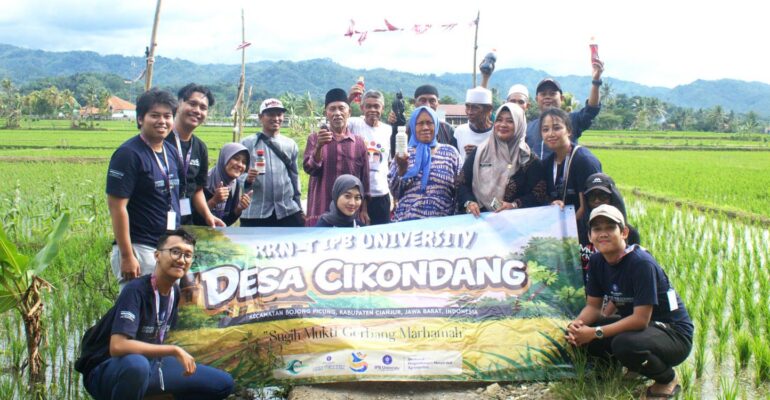
Jadam Sulfur fungicide is an innovation developed by students participating in the IPB Innovation Real Thematic Work Lecture (KKNT) to promote farmer independence in Cikondang Village, Cianjur Regency, West Java. This program is designed as an effort to introduce an alternative fungicide made from sulfur, which is environmentally friendly and sustainable.
Jadam sulfur is an organic pesticide formulation developed from the “Jadam” (Jayonul Damun Saramdul) concept originating from South Korea. It is based on the principles of low cost, easily obtainable ingredients, and can be made independently by farmers. In addition to being low cost, the production of sulfur jadam minimizes the risk of chemical residues and has a relatively safer environmental impact on the soil.
“Jadam sulfur is a safe fungicide alternative that can be made independently by farmers using easily obtainable ingredients,” said Khairunnisa Lastanti Putri, a student at the Department of Agronomy and Horticulture at IPB University and a member of the Cikondang Village KKNT innovation .
“Its use is also more environmentally friendly compared to synthetic chemical fungicides,” she added.
The suitability of the KKNT inovation program with the problems in the field was expressed directly by local farmers. Fungal disease attacks during the rainy season have been considered a major obstacle because they require significant control costs.
“We are often overwhelmed during the rainy season because fungal diseases spread quickly and the cost of medicine is quite expensive. This sulfur material is suitable for the conditions we experience and can be a more affordable solution,” said Alwi Mughni, Chief of the Giritani 05 Farmer Group, Cikondang Village.
Erti Yulianti, Field Agricultural Extension Officer (PPL) of Cikondang Village, also added that the appropriate dosage and method of application are key to the successful use of sulfur powder in the field.
“If applied correctly, this fungicide can help farmers control plant diseases effectively and sustainably,” she said.
She hopes that the innovation introduced through the IPB University KKN activity can continue to be applied by local farmers.
“With continuous assistance, farmers can utilize sulfur powder as a more economical and environmentally friendly alternative for controlling plant diseases,” added Erti.
At the end of the activity, IPB University KKNT innovation students handed over the sulfur-based fungicide to the farmers’ group as an example of a ready to use product.
This program is expected to encourage farmers’ independence in applying sustainable and environmentally friendly alternative agricultural technologies in Cikondang Village. (IAAS/SSR)