Faculty of Agriculture of IPB University Pioneers National Upland Rice Development
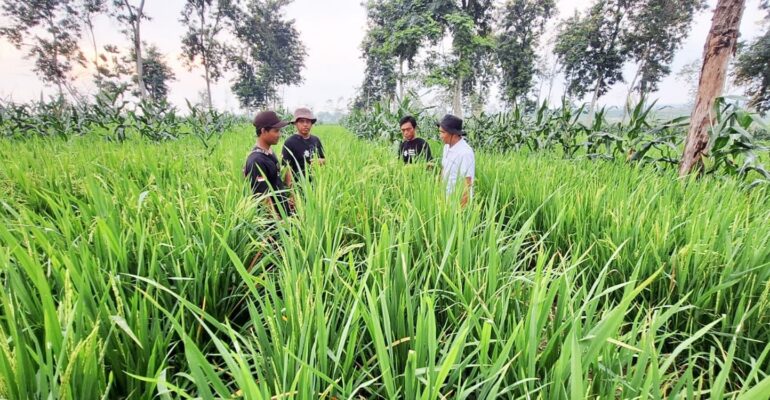
The Faculty of Agriculture of IPB University pioneers the development and implementation of upland rice as a main strategy in strengthening the national food system. Throughout 2025, the upland rice system has been developed by the Faculty of Agriculture of IPB University in various regions across Indonesia, including Pati, Gunungkidul, Bogor, Murung Raya, and Berau.
The development of upland rice is carried out through the application of integrated technology, which includes the use of the IPB 9G superior variety, the use of microbes to increase plant tolerance to drought, pests, and diseases, the regulation of cultivation activities with an automatic weather station (AWS), and the optimization of fertilization.
Based on field implementation results, upland rice productivity was recorded to range from 3,5 to 5 tons of harvested dry unhusked rice (GKP) per hectare.
The Dean of the Faculty of Agriculture of IPB University, Prof Suryo Wiyono, emphasized that upland rice plays a strategic role amid increasingly drier climatic conditions.
“The upland rice system is a key strategy for improving food security. The technology is available, the land is there, and Indonesia will become drier in the future. To date, upland rice is estimated to contribute only around 5 percent of total national rice production, so it needs to be increased to 15 percent,” said Prof Suryo.
He added that the Faculty of Agriculture at IPB University will continue to lead the development of upland rice through various technology dissemination programs and socio economic studies.
“Thus, in the future, upland rice can become the backbone of fulfilling national rice needs,” he added.
The impact of this technology has also been felt directly by farmers. Sudargo (45 years), an upland rice farmer in Ronggo Village, Jaken District, Pati Regency, said that technological assistance has brought about real change.
“We have started planting IPB 9G rice and using drought resistant microbial technology since 2020 with assistance from IPB. Now, with proper management, upland rice cultivation can match and even exceed corn, so many relatives and neighbors have started planting upland rice around the teak forest area,” he said.
Meanwhile, Prof Suwarto, Professor of Agronomy at IPB University who specializes in upland rice research, said, “Upland rice has great potential because Indonesia has millions of hectares of available and suitable dry land, while the conversion of rice fields is occurring on a massive scale.”
Looking ahead, the development of upland rice is expected to further expand the utilization of dry land in Indonesia and serve as a sustainable solution in ensuring national food security. (*/Rz) (IAAS/FHD)