Prof Faroby: Coffee–Durian Planting Is the Best Agroforestry Model for Transmigration Areas
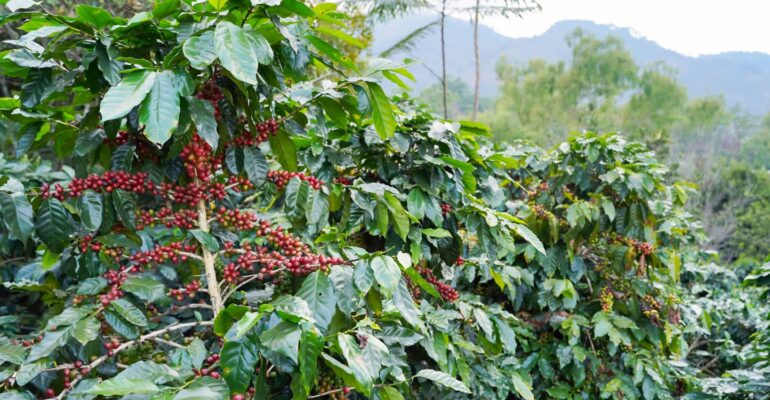
The combination of coffee and durian cultivation is considered the most profitable agroforestry model for development in transmigration areas. This system not only generates higher income for local communities but also contributes significantly to low carbon development.
This conclusion was presented by Prof A Faroby Falatehan, Professor of Agricultural Economics and Sustainable Resource Policy at IPB University.
Prof Faroby highlighted the common challenges faced by transmigrants, particularly the low income they experience during the early planting period. Many eventually leave their settlements because they are unwilling to wait for plantation crops such as coffee or durian to reach their productive stage.
“Most communities will plant fast-growing crops, such as horticulture or staple foods, so they can earn income within the first year,” he explained.
He cited the transmigration area in Lamandau Regency, Central Kalimantan, which has implemented a 100-hectare corporate farming model for coffee. However, reliance on coffee monoculture poses risks due to price fluctuations and the long waiting period before harvest.
“In the field, some residents have switched to oil palm because they consider it more profitable than coffee. Monoculture makes income dependent on a single commodity,” he said.
Coffee–Durian: The Best Model
Based on his financial feasibility analysis, Prof Faroby showed that the coffee–durian agroforestry system offers the highest economic value. The scheme produces a net present value (NPV) of around Rp1 billion, a benefit-cost ratio (BCR) of more than 11, and an internal rate of return (IRR) reaching 39 percent. These figures far exceed coffee monoculture, which generates an NPV of only around Rp 218 million.
“Agroforestry provides dual income, maintains soil moisture, reduces erosion, and enhances carbon absorption. The coffee–durian model is the best option both economically and environmentally,” said the lecturer from the Faculty of Economics and Management, IPB University.
Environmentally, the coffee–durian combination also proves to capture more carbon emissions. “An agroforestry system on 100 hectares can absorb 9.938 tons of CO₂e over 20 years. This supports the national emission reduction targets,” he said.
This carbon-reduction value also has potential for trade in the voluntary carbon market (VCM), although its implementation requires extensive expertise and certified institutions.
Prof Faroby emphasized that the success of the agroforestry model depends on the strengthening of transmigration institutions. He proposed establishing BUMTrans and a consortium to serve as carbon aggregators, developing a digital monitoring–reporting–
“In conclusion, the financial advantages of agroforestry are far greater than monoculture. This approach also plays a crucial role in carbon economics and environmental sustainability,” he stated.
He closed his presentation with a reflective message. “When transmigrants plant coffee and durian, they are essentially planting the future of Indonesia, a future that is green, resilient, and ecologically just. Transmigration is not a chapter from Indonesia’s old development narrative, but the beginning of a new era of green civilization.” (Fj) (IAAS/TIR)