
PKSPL IPB University and Temburun Community Group Collaborate on Mangrove Crab Restocking at Senggalong Beach, Anambas
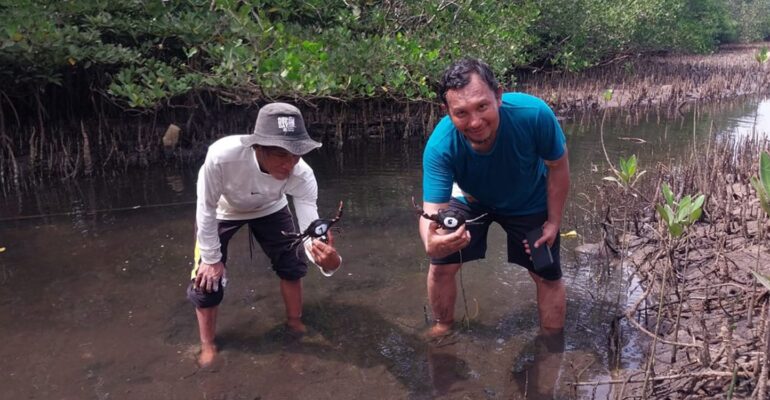
The Center for Coastal and Marine Resources Studies (PKSPL) at IPB University, together with the Community Group (Pokmas) of Temburun Village, successfully carried out a crab restocking activity (reintroduction) of mangrove crabs (Scylla serrata) in the Senggalong Beach area, Anambas Islands Regency.
This activity is part of the research and community service program of PKSPL IPB University in supporting sustainable community-based coastal resource conservation. The main focus is on the study of the maintenance and recovery of the mangrove crab population, which has high economic value and plays a vital ecological role in mangrove forests.
PKSPL IPB University, represented by Dr Irzal Effendi and Muhammad Qustam Sahibuddin, M.Si., stated that this collaboration is an important step to ensure the sustainability of the restoration program.
“We released the mangrove crabs after keeping them for some time in special containers in the Senggalong Beach area. This location has a mangrove area that has improved, which was previously eroded by the sea,” said Dr Irzal.
According to him, the success of this program greatly depends on the commitment of Pokmas and the Temburun Village community in managing and monitoring the habitat.
He further said, “We tagged the released mangrove crabs to monitor their direction and range of travel. At the same time, we are assessing the growth and reproduction of this species.”
Monitoring the presence of the released mangrove crabs—including post-molting shells—is carried out together with the community through the Pokmas, with an incentive scheme.
Hasmadi, a representative of the Temburun Village Pokmas, expressed his gratitude and commitment. “We welcome the assistance and guidance from IPB University. This activity has provided us with new knowledge about proper cultivation and conservation methods. We are committed to protecting this area because mangrove crabs are the future of our livelihood,” he said.
It is hoped that within 6-12 months, the mangrove crab population on Senggalong Beach will increase. Ultimately, this will have a positive impact on increasing the catch of local fishermen, both for consumption and for the sustainable supply of seeds. This is because mangrove crab cultivation has so far relied on seeds caught from the wild (fisheries-based aquaculture).
“Collaborations like this must continue to be encouraged. Through a scientific approach from IPB University and the local wisdom of Pokmas, we can ensure that the Anambas Islands ecosystem remains sustainable and provides economic benefits to the community,” concluded Dr Irzal Effendi. (*/Rz) (IAAS/LAN)

